
The 100 envelope challenge is a savings game: you number 100 envelopes from 1 to 100, and each time you save, you fill one envelope with its number in dollars. Fill all 100 and you have $5,050. Most people fill two envelopes a week and finish in 50 weeks.
The 100 envelope challenge saves $5,050. See the $101-a-week pairing trick, biweekly and smaller versions, and four printable envelope trackers.
The hard part is not the idea. It is the second half, when envelopes 70 to 100 ask for $70 to $100 each. The pairing trick below fixes that by making every week cost exactly $101.
You will also find a biweekly paycheck schedule, smaller $1,275 and $2,525 versions, a $10,100 version, and four printable trackers to color in.
Table of Contents 19 sections
100 Envelope Challenge Versions at a Glance
Pick the version that fits your budget. Every total is the sum of the envelopes in it.
| Version | Envelopes | Total Saved | Pairing Pace | Weeks |
|---|---|---|---|---|
| Classic | 1 to 100 ($1 to $100) | $5,050 | $101 a week | 50 |
| Half version | 1 to 100 ($0.50 to $50) | $2,525 | $50.50 a week | 50 |
| 50 envelopes | 1 to 50 ($1 to $50) | $1,275 | $51 a week | 25 |
| Double version | 1 to 100 ($2 to $200) | $10,100 | $202 a week | 50 |
Step 1: Number Your Envelopes and Pick a Version
Write the numbers 1 to 100 on plain envelopes, or print the tracker below if you would rather save digitally. Before you start, decide which version fits. The classic one averages about $101 a week, which is more than many budgets can carry.
If $101 a week would mean skipping bills, choose the half version or the 50-envelope version. A smaller challenge you finish beats a big one you quit in March.
Step 2: Use the Pairing Trick to Keep Every Week the Same
Here is the trick that makes the 100 envelope challenge manageable: fill two envelopes each week, always one low and one high, so they add up to $101. Envelope 1 goes with 100, 2 with 99, 3 with 98, and so on.
There are 50 pairs, so the challenge takes 50 weeks at exactly $101 each. No week is harder than another, and you can set up one automatic transfer for the same amount every Friday.
Step 3: Match the Schedule to Your Paycheck
If you are paid every two weeks, fill two pairs on each payday: that is $202 per biweekly paycheck. With 26 paychecks in a year, you finish after 25 paydays, with one paycheck to spare for a slow month.
Paid monthly? Fill about eight or nine envelopes on payday, choosing pairs so the total stays near $440. Twelve months at that pace reaches $5,050 with a little room to spare.
For more ways to run a challenge on payday, our 52 week money saving challenge has weekly and biweekly charts that pair well with this one.
Step 4: Decide Where the Money Lives
Real envelopes full of cash feel great, but $5,050 in a drawer is a risk. Cash at home is not protected if it is lost, stolen or damaged, and it is easy to borrow from.
A good middle path: stuff the envelope for the moment, then deposit the cash into a high-yield savings account once a month. Deposits at an FDIC-insured bank are covered up to $250,000 per depositor, per bank, for each account ownership category.
Prefer to skip the cash entirely? Transfer the amount and simply color the envelope number on a savings tracker. You get the same game without the risk.
Step 5: Track Every Envelope You Fill
Keep the tracker on the fridge or inside your savings binder. Color the two numbers you filled each week, and write the date in the margin.
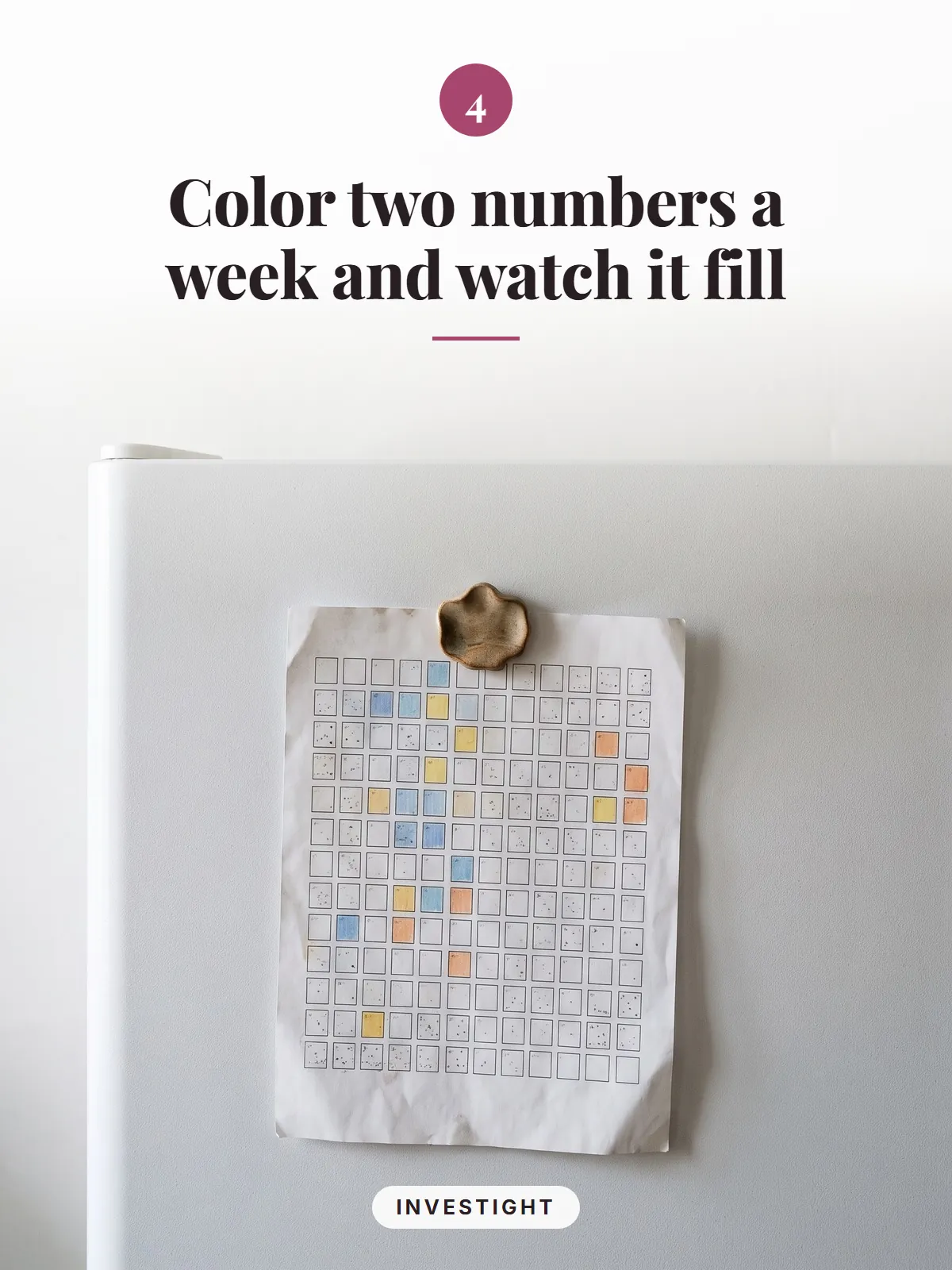
A visible tracker is what keeps people going in week 30. You can see 60 numbers colored in and only 40 left, and it becomes much harder to stop.
For more trackers, including Christmas, $1,000 and $10,000 versions, browse our savings challenges.
Step 6: Plan for the Hard Weeks Before They Arrive
Even with pairing, some weeks will be tight. Decide your rule in advance: if a week is short, you can fill one envelope instead of two and catch up on the next good week.
Keep a short list of quick boosts for those catch-up weeks: sell one item you no longer use, skip takeout for a week, or send part of a refund or bonus straight to the challenge.

Which 100 Envelope Challenge Schedule Fits You
There is no single correct pace. The best 100 envelope challenge schedule is the one that lines up with when money actually lands in your account.
| Schedule | How It Works | Amount Each Time | Time to Finish |
|---|---|---|---|
| Daily | One envelope a day, any order | $1 to $100, about $50.50 on average | 100 days |
| Weekly pairs | Two envelopes adding to $101 | $101 | 50 weeks |
| Biweekly paycheck | Four envelopes, two pairs | $202 | 25 paychecks |
| Monthly | Eight or nine envelopes | About $420 to $440 | 12 months |
The famous "save $5,050 in 100 days" version is the daily schedule. It works for people with a large monthly surplus, but it asks for about $1,500 a month on average. For most households, the weekly or biweekly version is far more realistic.
Smaller Versions That Still Feel Like a Win
If $5,050 is out of reach right now, scale the challenge down. You keep the fun of filling envelopes, and the habit is exactly the same.
The half version uses the same 100 envelopes, but each one holds half its number: envelope 1 holds 50 cents and envelope 100 holds $50. Pairs add up to $50.50, and the total is $2,525 in 50 weeks.
The 50-envelope version uses only envelopes 1 to 50. Pairs add up to $51 (1 with 50, 2 with 49), and you finish in 25 weeks with $1,275. It is a great first challenge or a way to build a starter emergency fund.
Some people also do a 25-envelope mini challenge for a single goal, like holiday gifts or a car repair fund. Envelopes 1 to 25 add up to $325.
The $10,000 Version: Doubling Every Envelope
The double version asks for twice each number: envelope 1 holds $2 and envelope 100 holds $200. Pairs add up to $202 a week, and the total is $10,100 in 50 weeks.
That is about $875 a month, so it suits two-income households or anyone with a clear savings surplus. If the numbers fit, it is one of the simplest ways to save $10,000 in a year, because the weekly amount never changes.
Try the classic version first if you are unsure. You can always switch to the double version halfway through by doubling the remaining envelopes.
What Your $5,050 Can Earn in a Savings Account
Moving each week's deposit into a high-yield savings account does more than keep the money safe. It pays you a little interest along the way.
Because the balance grows from $0 to $5,050 over the year, your average balance is roughly half the total, about $2,525. At an example rate of 3.5% APY, that average balance earns roughly $85 to $90 in the first year. Rates change often, so check your bank's current rate.
It is not life-changing money, but it is enough to cover a few weeks of the challenge. Cash in envelopes at home earns nothing.
Cash Stuffing Without the Risk
The 100 envelope challenge grew out of cash stuffing, the habit of splitting cash into labeled envelopes. Many people love the feel of real bills, and that is fine, as long as you set a few rules.
Keep envelopes in one secure place, not spread around the house. Deposit them regularly, ideally once a month, so the amount at home stays small. Use a binder with zip pockets if you want the look of cash stuffing without loose envelopes.
If you withdraw cash every week to stuff, watch for ATM fees. A $3 fee each week costs $150 over 50 weeks, which defeats part of the purpose. Use your own bank's ATM or get cash back at the grocery store.
100 Envelope Challenge Mistakes to Avoid
Filling envelopes in random order with no plan. Random picks are fun, but they can leave you with every big envelope at the end. Pairing keeps the effort even.
Starting the classic version on a tight budget. If $101 a week means paying a bill late, you are not saving, you are moving the problem. Pick a version that fits.
Keeping $5,000 in cash at home. It is unprotected and easy to borrow from. Deposit regularly into a separate savings account.
Not naming the goal. Write what the money is for on the tracker. An emergency fund, a car or a debt payoff gives the challenge a reason when motivation runs low.
How to Set Up a 100 Envelope Challenge Binder
A binder keeps 100 envelopes tidy and makes the challenge feel like a project instead of a pile of paper. You need a small ring binder, clear zip pockets or envelopes with punched holes, and a printed tracker for the front.
Number the pockets 1 to 100, or group them ten to a pocket so the binder stays slim. Put the tracker on the first page and a pen in the front pocket, so coloring a number takes two seconds.
If you prefer a smaller setup, use a recipe box or a shoebox with dividers. The look does not matter. What matters is that it lives in one spot and that every envelope ends up in the bank.
Doing the Challenge as a Couple or a Family
Two people can split the 100 envelope challenge and finish twice as fast, or keep the same pace with half the cost each. If each partner fills one pair a week, the household saves $202 a week and reaches $5,050 in 25 weeks.
Couples with different incomes can split by percentage. If one partner earns 60% of the household income, they fill three pairs out of every five. The total still adds up to $101 per pair.
Kids can join with a mini version. Give them envelopes 1 to 20 in quarters, so envelope 1 holds 25 cents and envelope 20 holds $5. The total is $52.50, a perfect goal for a toy or a gift.
Using the Envelopes to Pay Off Debt
The 100 envelope challenge does not have to end in a savings account. Some people use it to pay down a credit card faster.
Fill your envelopes as usual, then send the month's total as an extra payment on your highest-rate card. At the classic pace, that is about $440 a month on top of your minimum payment.
Color the envelope numbers as you go, and write the card's new balance in the margin each month. Watching both the colored numbers and the falling balance is a strong double boost of motivation.
What to Do When You Finish
Finishing the 100 envelope challenge is a real milestone, so decide where the money goes before the last envelope is filled.
If you do not have an emergency fund, keep it as one. $5,050 covers most common surprises, like a car repair or a medical bill, and lets you stop relying on credit cards for them.
If you carry credit card debt, consider using part of it to pay down the card with the highest interest rate. If both are handled, put it toward a named goal or start the next challenge right away, while the weekly habit is still strong.
Frequently Asked Questions
How much do you save with the 100 envelope challenge?
The classic 100 envelope challenge saves $5,050, because the numbers 1 to 100 add up to 5,050. The half version saves $2,525 and the 50-envelope version saves $1,275.
How long does the 100 envelope challenge take?
It depends on your pace. One envelope a day takes 100 days. Two envelopes a week, paired to $101, takes 50 weeks. Two pairs per biweekly paycheck takes 25 paydays.
Is the 100 envelope challenge realistic?
The daily version asks for about $1,500 a month, which is too much for most budgets. The weekly pairing version is $101 a week, and the half version is $50.50 a week, which is much more realistic.
Do I have to use real envelopes and cash?
No. You can transfer each amount to a savings account and color the number on a printed tracker. Many people use real envelopes for a few days, then deposit the cash every month.
What is the easiest way to do the 100 envelope challenge?
Pair a low envelope with a high one each week so every week costs $101, automate a weekly transfer for that amount and color two numbers on your tracker every time it goes through.
Can I do the 100 envelope challenge on a low income?
Yes. Try the half version at $50.50 a week or the 50-envelope version at $51 a week for 25 weeks. A quarter version, where each envelope holds a quarter of its number, saves $1,262.50 at about $25 a week.
Can I start the 100 envelope challenge in the middle of the year?
Yes. Start any week and count 50 weeks from there. If you want to finish by a set date, like December, divide the remaining pairs across the weeks you have and fill more than two envelopes on paydays.
Where should I keep the money from the 100 envelope challenge?
Keep it in a separate savings account, ideally a high-yield one at an FDIC-insured bank or a federally insured credit union. If you use real envelopes, deposit the cash at least once a month so a large amount is never sitting at home.
What if I miss a week of the 100 envelope challenge?
Do not restart. Fill one extra pair on your next good week, or add the missed pair to the end and finish a week later. The total is the same either way.
Start Your First Pair This Week
You do not need $5,050 to start. You need two envelopes, $101 or $50.50, and a place to keep the money where you will not touch it.
Print your tracker, fill envelopes 1 and 100 this week and color them in. Fifty weeks from now, the 100 envelope challenge will have turned a small weekly habit into one of the biggest savings wins of your year.
Pin this guide to your money board
Save this saving money guide on Pinterest so the numbers and checklist are there when you need them.
Save on PinterestThis guide is general education, not individualized financial, tax, or investment advice. Figures reflect rules in effect on Nov 20, 2026. See our financial disclaimer.
