

The 52 week money saving challenge is simple: you save $1 in week one, $2 in week two, and keep adding a dollar each week until you save $52 in week 52. By the end of the year, you have $1,378, and you barely felt the early weeks.
Try the 52 week money saving challenge your way: classic $1,378, reverse, double, biweekly, $5,000 and $10k versions, each with a printable tracker.
The classic version is only one option. You can reverse it, double it, run it by paycheck, or use fixed weekly amounts to reach $5,000 or $10,000.
Below are all the versions with their exact totals, a trick to make December easier, and a printable tracker for each one so you can color in your progress all year.
Table of Contents 17 sections
52 Week Money Saving Challenge Versions and Totals
Pick the version that fits your paycheck. Every total here is calculated, so you know exactly what you will have in 52 weeks.
| Version | How It Works | First Deposit | Last Deposit | Total Saved |
|---|---|---|---|---|
| Classic | Add $1 every week | $1 | $52 | $1,378 |
| Reverse | Start at $52, go down by $1 | $52 | $1 | $1,378 |
| Mini | Add 50 cents every week | $0.50 | $26 | $689 |
| Double | Add $2 every week | $2 | $104 | $2,756 |
| Five-dollar | Add $5 every week | $5 | $260 | $6,890 |
| Biweekly | Two weeks per paycheck, 26 deposits | $3 | $103 | $1,378 |
| Fixed $5,000 | Same amount every week | $96.15 | $96.15 | about $5,000 |
| Fixed $10,000 | Same amount every week | $192.31 | $192.31 | about $10,000 |
Step 1: Pick the Version That Fits Your Paycheck
Start with what feels easy in week one but still doable in week 52. The classic version asks for $52 at the end, so make sure that number fits your budget before you commit.
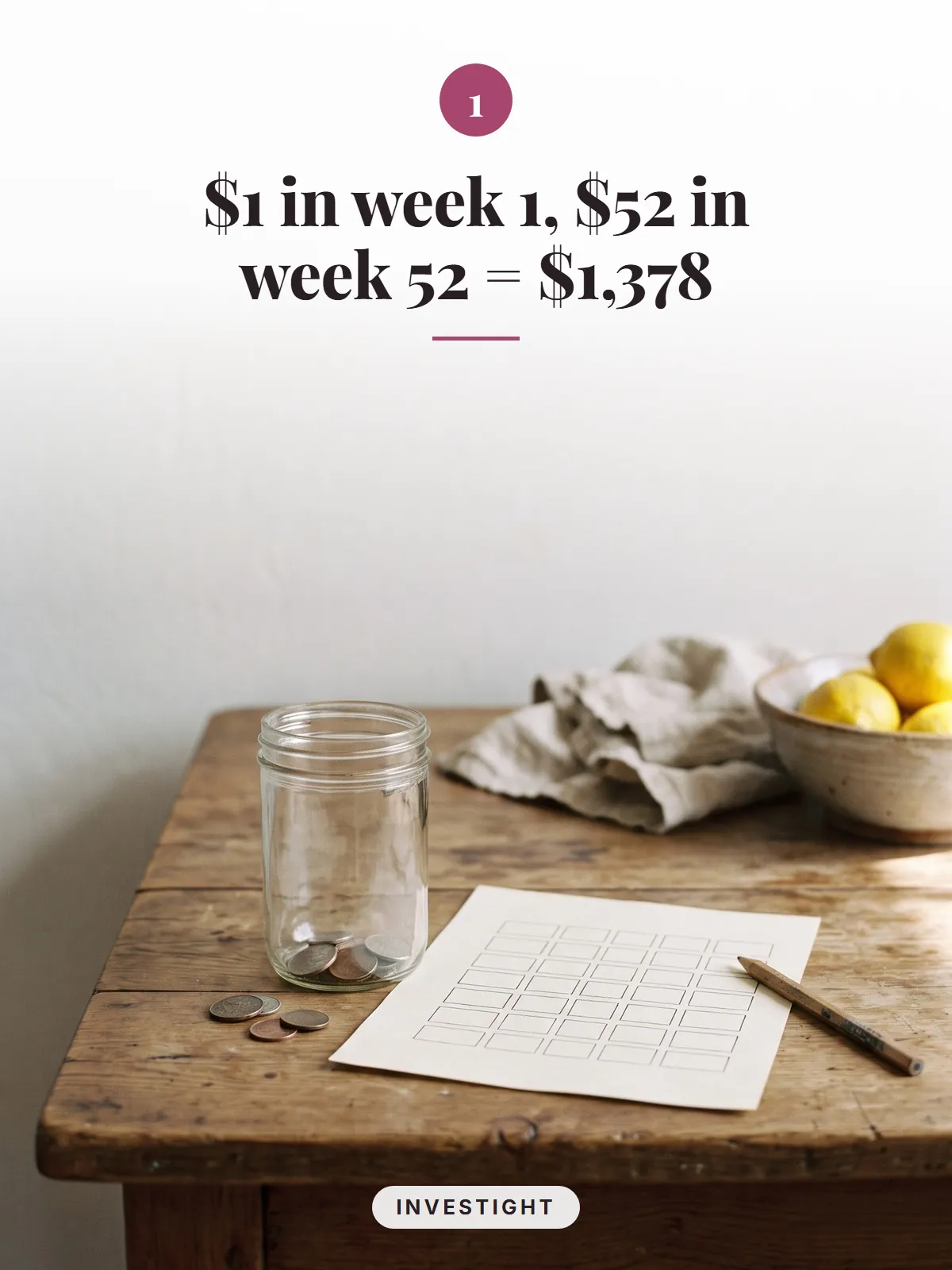
If money is tight, the mini version saves $689 with deposits under $26. If you want a bigger result and your budget has room, the double version reaches $2,756, and the five-dollar version reaches $6,890.
Have a specific goal, like a $5,000 emergency fund? Fixed amounts are easier to plan around. Saving $96.15 every week gets you to about $5,000, and $192.31 a week gets you to about $10,000.
Step 2: Choose Your Start Date
Most people start the 52 week challenge in the first week of January, as a New Year's resolution they can actually keep. But any Monday works. The challenge is 52 weeks long, not tied to the calendar year.
Starting in January has one downside with the classic version: your biggest deposits land in November and December, right when holiday costs pile up. If that worries you, read step four before you begin.
Write your start date at the top of your tracker. Seeing week 1 checked off on day one is a small win that keeps you going.
Step 3: Open a Separate Savings Account and Automate It
Keep your challenge money away from your checking account. A separate high-yield savings account makes the balance harder to spend and earns a little interest along the way.
With the classic version, the interest is small but real. At 3.5% APY, the growing balance earns about $16 over the year. With the $10,000 version, it can add up to well over $100.
Set up an automatic transfer for the same day each week, or each payday. Many banks let you schedule a repeating transfer and change the amount whenever you like, which makes the increasing amounts easy.
Step 4: Reverse It So December Is the Easy Month
This is the trick most guides skip. In the reverse version, you save $52 in week one and $1 in week 52. Your biggest deposits land in the new year, when motivation is high, and your smallest land in December.

You still save the same $1,378. You just move the hard weeks to the part of the year when you have the most energy and the fewest holiday bills.
If you start in the summer, the classic version can work better, because your biggest weeks fall in the spring. Count forward from your start date and check which months get the $40 to $52 weeks.
Step 5: Run It by Paycheck Instead of by Week
If you are paid every two weeks, save two weeks at once. Paycheck one covers weeks 1 and 2, so you save $3. Paycheck two covers weeks 3 and 4, so you save $7, and so on.
Your last biweekly paycheck covers weeks 51 and 52, which is $103. Over 26 paychecks you still save $1,378, with half as many transfers to remember.
For fixed goals, the biweekly math is easy too: about $192.31 per paycheck reaches $5,000, and about $384.62 per paycheck reaches $10,000.
Step 6: Track It Where You Will See It
A savings tracker turns a boring transfer into something you look forward to. Print the tracker for your version, tape it inside a cabinet door, and color in each week the moment the money moves.
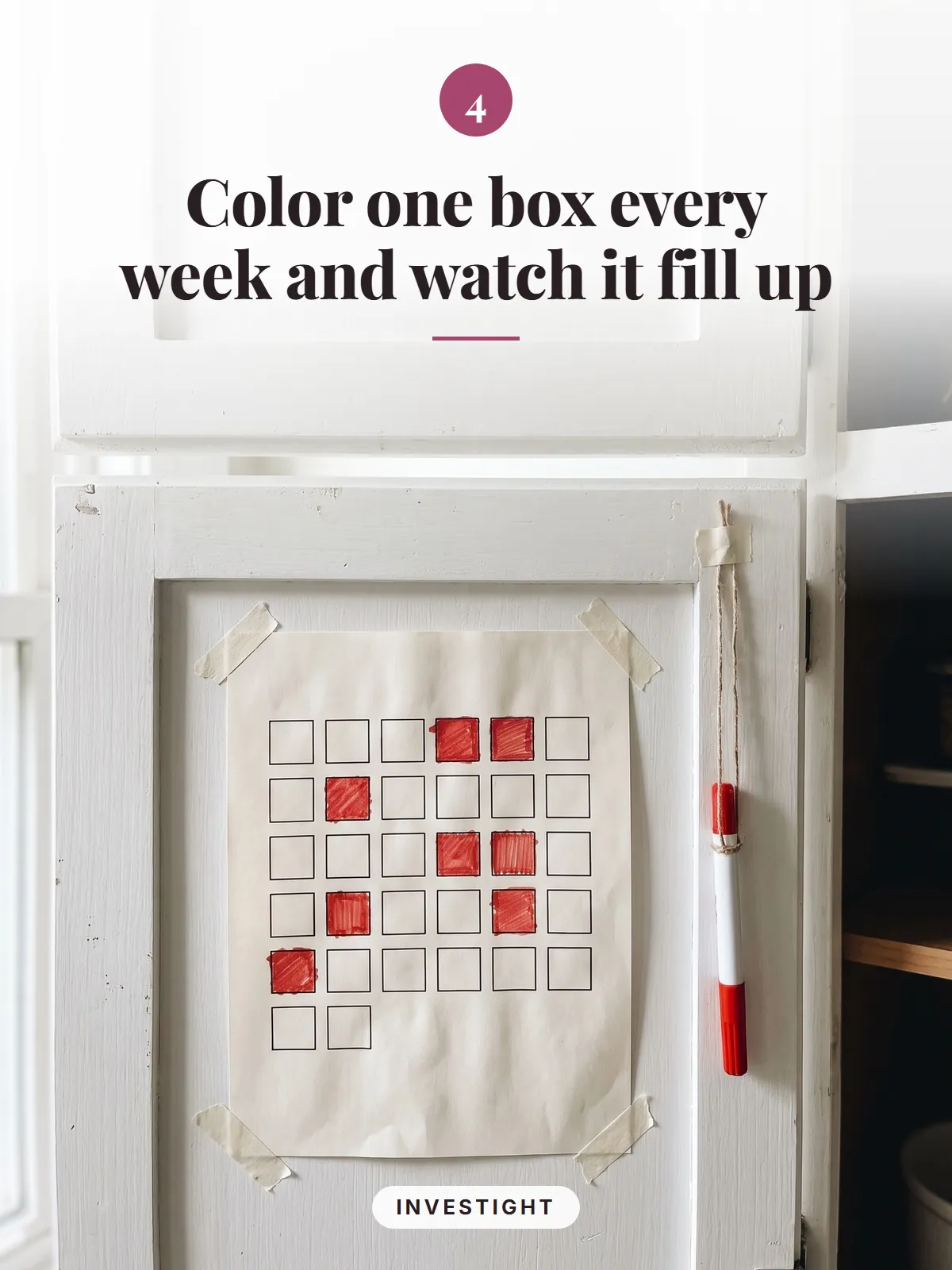
Some people like a cash envelope version: 52 numbered envelopes in a box, filled week by week, then deposited each month. It feels satisfying, but move the cash to the bank regularly so it stays safe.
Want more trackers for other goals? Our savings challenge printable collection has options for $500 to $20,000, and our savings challenges hub covers envelope and 100-day challenges too.
Step 7: What to Do If You Miss a Week
Missing a week does not end the challenge. Either make up the amount on your next payday, or move that week to the end of the year and keep going.

If a big week lands at a bad time, swap it with a smaller week. Week 45 and week 5 add up to the same total either way. Your tracker is a tool, not a contract.
The only real way to fail the 52 week challenge is to stop. Even if you finish with $1,100 instead of $1,378, you still built a weekly saving habit, and that habit is worth more than the exact number.
What You Can Do With $1,378
A finished 52 week money saving challenge is a real chunk of money. Decide what it is for before you start, because a named goal is much harder to raid halfway through.
The most common choice is a starter emergency fund. $1,378 covers a surprise car repair, a vet visit or a new tire without touching a credit card.
Others use it to pay off a small debt in one go, to cover next year's Christmas in cash, or as a down payment on a bigger goal. Some people roll straight into the double version the next year, aiming for $2,756.
Whatever you choose, write it at the top of your tracker. Week 30 feels very different when it says "Emergency fund" instead of "Savings challenge."
Turn It Into a Couple or Family Challenge
The 52 week challenge is easier with a partner. Split the weeks: one of you takes the odd weeks and the other takes the even weeks. Each person's largest deposit is $52 or $51, and the shared total is still $1,378.
Running the double version together is a nice middle ground. Each of you saves the classic amounts, and together you reach $2,756 without either person carrying the whole load.
Kids can join with the mini version. Saving 50 cents in week one up to $26 in week 52 adds up to $689, and coloring the tracker teaches them how small amounts grow.
Make the finish line visible. A family that agrees the money pays for a summer trip, a new mattress or a holiday dinner is much more likely to keep going in the slow middle months, usually around weeks 20 to 35.
Your Classic Challenge, Quarter by Quarter
The classic version starts gently and gets harder each season. Knowing the quarterly totals helps you plan, especially if your biggest weeks line up with holidays or back-to-school costs.
| Quarter | Weeks | Saved That Quarter | Running Total |
|---|---|---|---|
| First | 1 to 13 | $91 | $91 |
| Second | 14 to 26 | $260 | $351 |
| Third | 27 to 39 | $429 | $780 |
| Fourth | 40 to 52 | $598 | $1,378 |
Notice that the last quarter alone is $598, more than the first half of the year combined. That is why the reverse version, or a midyear start, is worth considering if your fall budget is already tight.
The 52 Week Challenge With Cash Envelopes
Some people prefer cash, because handing over real bills feels more serious than a transfer. Number 52 envelopes, keep them in a box or a binder, and fill one each week with that week's amount.
Pull the cash from your paycheck on payday, before you spend anything else. Put it straight into the week's envelope and color that box on your tracker.
Do not let the cash pile up at home all year. Once a month, deposit the full envelopes into your savings account and keep the empty envelopes as a record of your progress. Your money stays safe, and it earns a little interest too.
A 52 Week Challenge on a Low Income
If $52 in one week is unrealistic, change the scale, not the habit. The mini version saves 50 cents in week one and $26 in week 52, for $689 a year.
You can also flatten the challenge. Saving the same $10 every week reaches $520 in a year, and $15 a week reaches $780. A steady small amount is easier to protect than a growing one.
Another option is a flexible tracker: write the 52 amounts on a sheet and save any one of them each week, crossing it off. On a tough week, save $3. On a good week, save $48. You finish when every amount is crossed off, whenever that is.
Common 52 Week Challenge Mistakes
Most people who stop the challenge make one of these mistakes. Knowing them in advance makes it much easier to finish.
Keeping the money in checking. If the savings sit next to your spending money, they slowly disappear into groceries and gas. A separate account is the single best fix.
Not automating it. Remembering a transfer every week for a year is hard. A scheduled transfer you update once a month takes the memory out of it.
Ignoring the big weeks. In the classic version, the last ten weeks total $475. Check where those weeks fall before you start and adjust the version or the start date.
Not naming the goal. A challenge with no purpose is easy to raid. Write the goal at the top of the tracker, so week 38 has a reason.
What to Do With Your Money at the End of the Year
Finishing the challenge is a real win, so decide in advance where the money goes. A plan for the total keeps it from slipping into everyday spending in January.
If you have no emergency fund, keep it as one. $1,378 covers many common surprises, like a car repair or a large medical bill, without a credit card.
If you carry credit card debt, consider sending part of it to the card with the highest interest rate. Paying off a 24% balance is a guaranteed return that savings accounts cannot match.
If both are handled, put it toward a named goal: a trip, a holiday fund or extra retirement savings. Then start the next year's challenge right away, maybe at a slightly bigger scale. Many people find the second year much easier than the first.
Frequently Asked Questions
How much do you save with the 52 week money saving challenge?
The classic version saves $1,378: $1 in week one, rising by $1 each week to $52 in week 52. The double version saves $2,756, and fixed weekly amounts of $96.15 or $192.31 reach about $5,000 or $10,000.
Can I start the 52 week challenge in the middle of the year?
Yes. The challenge runs for 52 weeks from whatever date you choose. Just check which months get the biggest deposits, and use the reverse version if they land near the holidays.
How do I do the 52 week challenge with biweekly pay?
Save two weeks at once on each paycheck. Your first paycheck saves $3, your second $7, and your last $103, for the same $1,378 total over 26 paychecks.
Where should I keep my 52 week challenge money?
In a separate high-yield savings account with an automatic weekly or payday transfer. It earns some interest, stays out of your everyday spending, and is safer than cash at home.
Is the 52 week money saving challenge worth it?
Yes, especially as a habit builder. The money is useful, but the bigger win is learning to save every week without thinking about it. Many people move on to bigger goals once the habit sticks.
Can I do the 52 week challenge with cash?
Yes. Fill numbered envelopes each week, color your tracker and deposit the cash into a savings account once a month so it stays safe and earns interest.
What if $52 a week is too much for me?
Try the mini version, which tops out at $26 and saves $689, or save a fixed $10 to $15 a week. Building the weekly habit matters more than the exact total.
What should I do with the money after the 52 week challenge?
Keep it as an emergency fund if you do not have one, pay down high-interest debt if you carry any, or put it toward a named goal. Then start the next year's challenge.
Should I keep my 52 week challenge money in a high-yield savings account?
Yes, if you can. A separate high-yield savings account keeps the money away from everyday spending and pays some interest while it grows. Most online banks let you open one in minutes with no minimum balance.
Print Your Tracker and Save Your First Dollar This Week
You do not need to wait for January. Pick your version, print the tracker and make your first deposit this week, even if it is just $1.
Fifty-two small deposits from now, you will have a real cushion and a habit that runs on autopilot. That is the quiet power of the 52 week money saving challenge.
Pin this guide to your money board
Save this saving money guide on Pinterest so the numbers and checklist are there when you need them.
Save on PinterestThis guide is general education, not individualized financial, tax, or investment advice. Figures reflect rules in effect on Nov 20, 2026. See our financial disclaimer.
