

A 10k savings challenge is a plan to save $10,000 by a set date, one deposit at a time. Over one year, it takes $192.31 a week, $384.62 per biweekly paycheck or $833.33 a month. Pick a time frame your income can carry, automate the deposit on payday and color a tracker as you go.
Plan a 10k savings challenge that fits your pay: weekly, biweekly and monthly amounts for 1 year, 6 months and 3 months, plus 5 printable trackers.
$10,000 is a big goal, and the honest question is whether your budget can support it. Below is the math for every time frame, a table showing what share of your take-home pay it takes, and a realistic plan to find the money.
You will also find five printable trackers: 100 boxes of $100, mixed boxes, biweekly, weekly and monthly.
Table of Contents 22 sections
How Much to Save for $10,000
Each amount is $10,000 divided by the number of deposits.
| Time Frame | Weekly | Biweekly | Monthly |
|---|---|---|---|
| 1 year | $192.31 | $384.62 | $833.33 |
| 10 months | $230.77 | $461.54 | $1,000 |
| 6 months | $384.62 | $769.23 | $1,666.67 |
| 3 months | $769.23 | About $1,538.46 | $3,333.33 |
Step 1: Check What $10,000 Means for Your Budget
Before you start, compare the monthly amount with your take-home pay. A one-year 10k savings challenge needs $833.33 a month. On $5,000 of take-home pay, that is about 17%. On $3,000, it is about 28%, which is hard without extra income.
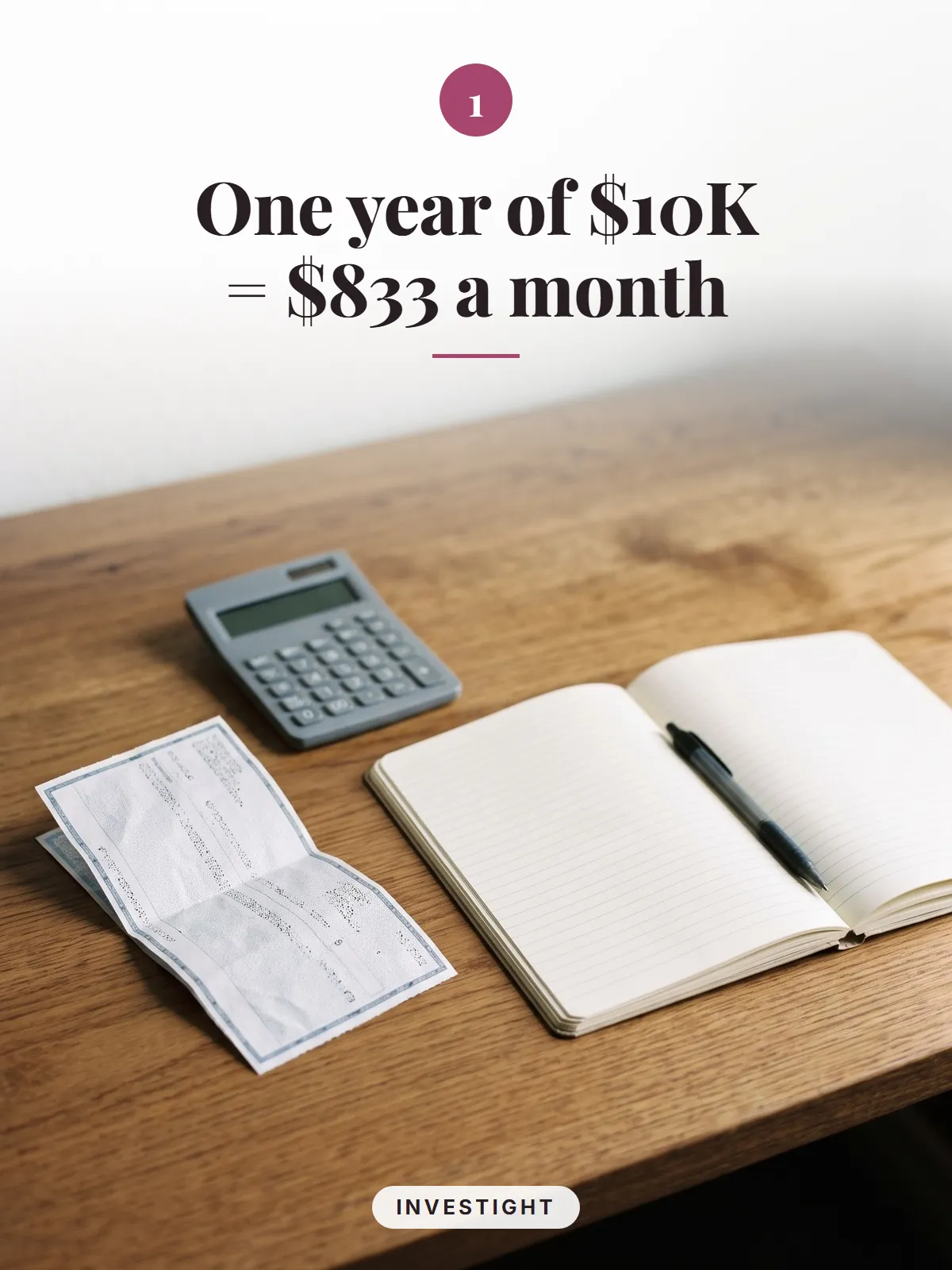
If the number is too high, choose a longer time frame or a smaller first goal like $5,000. You can always raise the goal once the habit is in place.
Step 2: Pick Your Time Frame
One year is the most realistic for most households. Six months needs $384.62 a week and usually takes two incomes or a strong side income. Three months is an emergency sprint, possible only with a large surplus or a windfall.
Ten months is a nice middle option: exactly $1,000 a month, which is easy to remember and easy to automate.
Step 3: Match the Deposits to Your Paychecks
If you are paid every two weeks, save $384.62 from each biweekly paycheck for a year. Two months a year bring a third paycheck, which can go entirely to the challenge and get you there early.
If you are paid weekly, $192.31 a week works. If you are paid monthly, set one $833.33 transfer the morning your pay arrives.
Step 4: Open a High-Yield Savings Account
Your $10,000 should live in a separate high-yield savings account, not in checking. It keeps the money out of sight, earns interest and makes impulse spending slower because transfers take a day or two.
Name the account after the goal. Many people call it "10K" or the purpose itself, like "House" or "Car". Make sure the bank is insured by the FDIC or the credit union by the NCUA.
Step 5: Automate Every Deposit
At this size, willpower alone rarely lasts a full year. Set an automatic transfer on payday for the full amount. If your employer allows it, split your direct deposit so part of each paycheck goes straight to savings.

For a smaller warm-up, our money saving challenges list has 24 options that build the same habit with lower amounts.
Step 6: Track Progress on a Printable
Print the tracker that fits your plan and color a box with each deposit. With $10,000, the 100-box tracker is especially satisfying: every $100 is one box, and you can see the full goal at a glance.
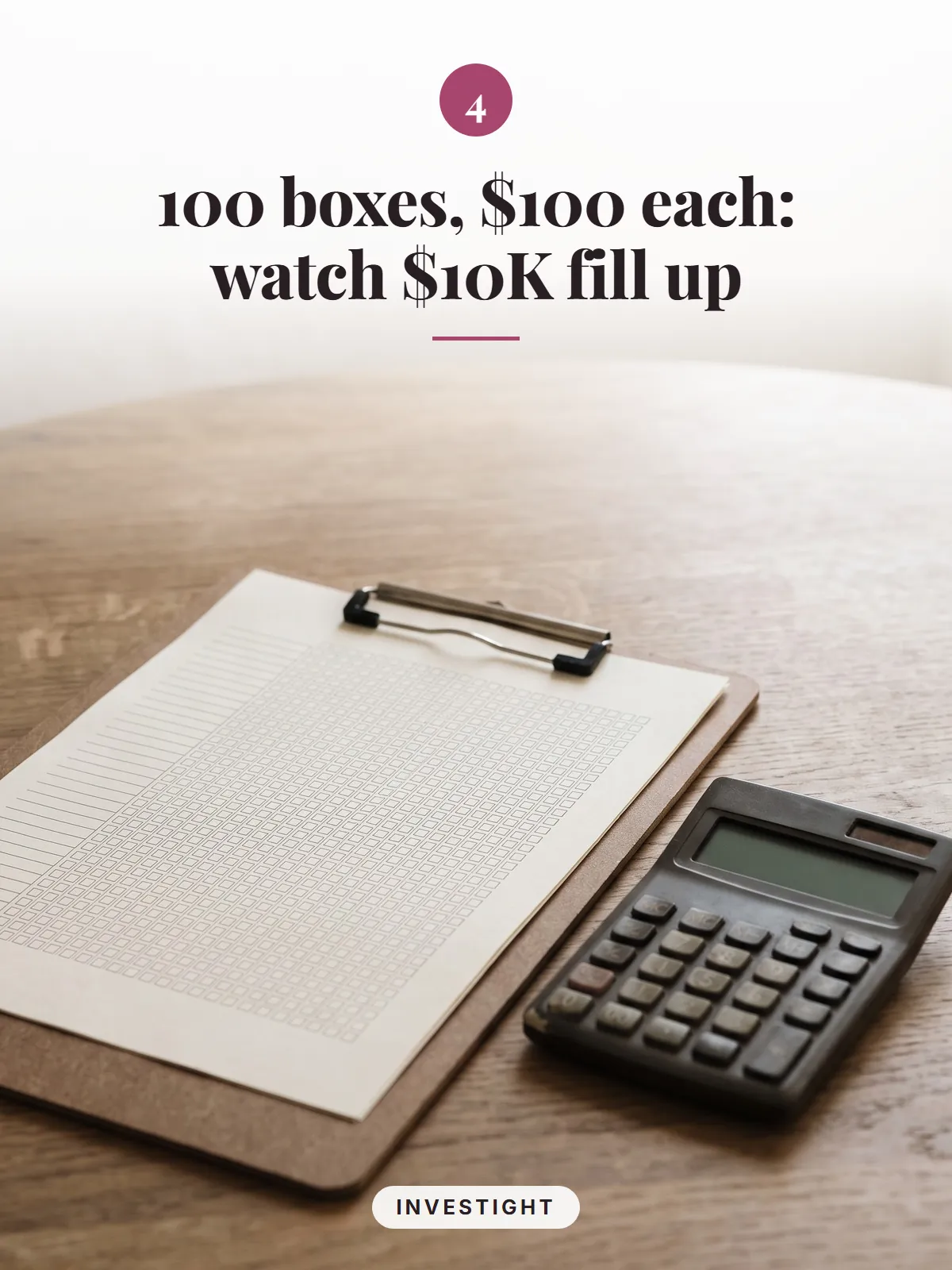
Check your savings account balance once a month and make sure it matches the colored boxes. If it does not, find out why before the gap grows.
Step 7: Plan for Hard Months
Over a year, something will go wrong: a car repair, a slow work month, a medical bill. Decide your rule in advance. A good one is to keep saving a smaller amount in a hard month rather than stopping completely.

Keep a separate small emergency fund if you can, so surprises do not come out of your 10K. Mixing the two makes both harder to track.
What Share of Your Take-Home Pay It Takes
This table shows how much of your monthly take-home pay a one-year 10k savings challenge uses at different incomes. It is the most useful number to look at before you commit.
| Monthly Take-Home Pay | $833.33 a Month Is |
|---|---|
| $3,000 | About 28% |
| $4,000 | About 21% |
| $5,000 | About 17% |
| $6,000 | About 14% |
| $8,000 | About 10% |
Below 15%, the challenge usually fits with a few cuts. Between 15% and 25%, it often needs a side income or a big cut, like a cheaper car or a roommate. Above 25%, consider a two-year plan or a $5,000 goal first.
Where to Find $833 a Month
Most people do not have $833 sitting unused every month. They build it from several sources at once. Here is one realistic mix for a household with $5,000 of take-home pay.
| Source | Monthly Amount |
|---|---|
| Current savings line, redirected | $250 |
| Groceries and eating out, planned meals | $200 |
| Subscriptions and phone plan | $60 |
| Insurance quotes and one refinanced bill | $90 |
| Side income, about 6 hours a week | $233 |
| Total | $833 |
The side income line matters most. At $10 to $20 an hour after taxes and costs, six hours a week of extra work can bring in $230 to $500 a month. Overtime, freelancing, tutoring, pet sitting and weekend shifts are common choices.
Windfalls also help. Sending a tax refund, a bonus or birthday money straight to the challenge can cover several months at once.
Can You Really Save $10K in 6 Months?
Six months means $384.62 a week, or $1,666.67 a month. For most single-income households, that is a stretch. It usually works in one of these situations.
You have two incomes and live on one. Many couples bank one full paycheck and live on the other for a set period. If one partner takes home $1,700 a month or more, saving all of it reaches $10,000 in six months.
You have a large side income. A second job or freelance work bringing in $1,000 or more a month, plus $650 in cuts, can do it.
You have a big windfall. A bonus or a tax refund can cover a large part of the goal at once.
If none of these apply, a one-year plan is the honest choice. There is nothing wrong with taking longer. The total is the same.
Can You Save $10K in 3 Months?
Three months needs about $3,333 a month. Unless you have a very high income, a large bonus or significant savings already, this pace usually means cutting essentials, which is not sustainable.
A safer approach is a 3-month sprint toward a smaller goal, like $2,000 to $3,000, followed by a steady pace for the rest of the year. You keep the energy of a sprint without risking bills or burning out.
The 100 Envelope Version: $10,100
If you like envelope challenges, the double 100 envelope challenge fits a 10K goal. Number 100 envelopes and fill each with twice its number: $2 in envelope 1 and $200 in envelope 100. The total is $10,100.
Pair a low envelope with a high one each week, like 1 with 100, and every week costs exactly $202. Fifty weeks later, you are done. Deposit the cash at least monthly so a large amount never sits at home.
What $10,000 Can Earn in a High-Yield Savings Account
Because your balance grows from $0 to $10,000 over the year, the average balance is roughly $5,000. At an example rate of 3.5% APY, that earns about $175 in the first year.
Once the full $10,000 is saved, the same rate earns about $350 a year. Rates change often, so check your bank's current rate before you choose an account. A regular checking account earns little or nothing.
What to Use Your $10,000 For
Deciding the purpose before you start makes the challenge much easier to finish. These are the most common goals.
A full emergency fund. For many households, $10,000 covers three to six months of essential expenses. It is the strongest financial safety net you can build.
A home down payment or closing costs. $10,000 is a meaningful start, especially for first-time buyer programs with lower down payment requirements.
A car paid in cash. Avoiding a car loan saves interest for years and frees up a monthly payment.
Paying off high-interest debt. If you carry credit card debt at 20% or more, sending part of the money there can save more than any savings account earns.
Side Hustle Ideas That Fit a 10K Goal
A side hustle is often what turns a 10k savings challenge from impossible into realistic. The best ones fit around your main job and pay steadily, even if the hourly rate is modest.
Weekend and evening shifts: retail, restaurants and warehouses often need extra help on weekends, especially in the fall and holiday season.
Skills you already have: tutoring, bookkeeping, writing, design or translation can be done in a few evening hours and often pay more per hour than general gig work.
Local services: pet sitting, dog walking, babysitting, lawn care and house cleaning are in steady demand in most neighborhoods, and regular clients make income predictable.
Selling: clearing out unused items, or buying and reselling furniture and clothes, can add a few hundred dollars a month for people who enjoy it.
Send every side hustle payment straight to your 10K account, and remember to set aside money for taxes on self-employment income.
The Two-Year Path: $10,000 on a Tighter Budget
If $833 a month does not fit, a two-year 10k savings challenge is a smart alternative. It needs $416.67 a month, $192.31 per biweekly paycheck or $96.15 a week.
On $3,500 of take-home pay, that is about 12% of income, which most households can reach with a few cuts and a small side income. You still end up with $10,000, just one year later.
Many people start with the two-year pace and speed up when income grows. A raise, a promotion or a paid-off car loan can be redirected to the challenge right away, and the finish line moves closer.
For more trackers at every goal size, browse our savings challenges.
Doing the 10K Challenge as a Couple
Couples are often the ones who finish a 10k savings challenge, because two incomes make $833 a month far more manageable. Split it evenly at $416.67 each, or by percentage of income.
Keep one shared tracker and one shared account for the goal. Check progress together once a month. Agree in advance what counts as a reason to pause, so neither partner feels the plan changed without them.
How to Stay Motivated for a Full Year
A year is a long time to stay focused on one number. Breaking it into smaller milestones keeps the 10k savings challenge feeling achievable.
Celebrate every $1,000. That is ten small wins across the year instead of one distant finish line. Mark each one on your tracker with a different color, and plan a low-cost reward, like a favorite home-cooked dinner or a day trip.
Write the purpose of the money at the top of the tracker and look at it when you are tempted to skip. A clear reason, like "no more car loans" or "three months of safety", is far more motivating than a round number.
10K Savings Challenge Mistakes to Avoid
Choosing a pace your income cannot carry. If the challenge means paying bills late or using credit cards, it is costing you money. Pick a longer time frame.
Skipping the emergency fund. Without a small separate cushion, the first surprise comes out of your 10K and progress feels lost.
Keeping it in checking. Ten thousand dollars next to your debit card is a strong temptation.
Not tracking. At this size, a missed month is easy to ignore. A printed savings tracker makes every gap visible.
Giving up after one setback. A hard month is not the end of the plan. Adjust the amount and keep going.
Frequently Asked Questions
How much do I need to save each week to reach $10,000 in a year?
$192.31 a week, or $384.62 per biweekly paycheck, or $833.33 a month. Saving $27.40 a day also reaches $10,000 in a year.
Is the 10k savings challenge realistic?
It depends on your income. On $5,000 of monthly take-home pay, it takes about 17% of your pay. On $3,000, it takes about 28%, which usually needs a side income or a longer time frame.
How can I save $10,000 in 6 months?
You need about $1,666.67 a month. It usually works when a couple lives on one income and saves the other, or with a strong side income or a windfall.
Where should I keep my $10,000?
In a separate high-yield savings account at an insured bank or credit union. It earns interest and keeps the money away from everyday spending.
Should I save $10,000 or pay off debt first?
If you carry high-interest credit card debt, paying it down often comes first after a small emergency fund. Low-interest debt can usually be paid on schedule while you save.
What is the best tracker for a 10k savings challenge?
The 100-box tracker, with one $100 box per deposit, is the easiest to read. The mixed-box tracker is more flexible if your deposits change from week to week.
Can I do a 10k savings challenge on a low income?
Yes, with a longer time frame. A two-year plan needs $416.67 a month, and a three-year plan about $277.78 a month. Starting with a $1,000 or $5,000 goal first is also a good way to build the habit.
What if I miss a month of my 10k savings challenge?
Do not restart. Spread the missed amount over the next three or four months, or extend the end date by one month. Every deposit you already made still counts toward the goal.
Start Your 10K Savings Challenge on Your Next Payday
Ten thousand dollars feels far away from the starting line. Broken into $384.62 per paycheck or $192.31 a week, it becomes a routine instead of a dream.
Check the share of your take-home pay, open the account, automate the first deposit and color your first box. A year from now, your 10k savings challenge will be one of the best decisions you made this year.

Pin this guide to your money board
Save this saving money guide on Pinterest so the numbers and checklist are there when you need them.
Save on PinterestThis guide is general education, not individualized financial, tax, or investment advice. Figures reflect rules in effect on Nov 20, 2026. See our financial disclaimer.
