

A $1000 savings challenge breaks one goal into small, regular deposits until you reach $1,000. Choose a time frame, divide $1,000 by the number of days, weeks or paychecks in it, and color a box on your tracker each time you save. One year takes $19.23 a week; 30 days takes about $33 a day.
Pick a $1000 savings challenge that fits your pay: 30-day, 60-day, 3-month, biweekly and 52-week plans, with five printable trackers to color in.
$1,000 is the most popular first savings goal for a reason. It is big enough to cover many common surprises, like a car repair or an urgent vet visit, and small enough to reach in a few months.
Below you will find the math for six time frames, a step-by-step plan, ideas to find the money, and five printable trackers, including a small-amounts version for tight budgets.
Table of Contents 21 sections
How Much to Save for $1,000
Find your time frame. Each amount is $1,000 divided by the number of deposits.
| Time Frame | Deposits | Amount Each Time |
|---|---|---|
| 30 days | 30 daily | $33.34 |
| 60 days | 60 daily | $16.67 |
| 3 months | 13 weekly | $76.92 |
| 6 months | 26 weekly | $38.46 |
| One year, biweekly | 26 paychecks | $38.46 |
| One year, weekly | 52 weekly | $19.23 |
Step 1: Pick a Time Frame You Can Keep
The fastest plan is not always the best one. A 30-day $1000 savings challenge asks for about $1,000 of spare money in a single month, which usually means big cuts or extra income.

If you have a clear surplus or a windfall coming, a short plan is great. If money is tight, choose six months or a year. A slow plan you finish beats a fast plan you abandon after a week.
Step 2: Find Your Amount and Your Day
Divide $1,000 by the number of deposits in your plan. Then pick a fixed day for each deposit, ideally payday, before you have a chance to spend anything.
If you are paid every two weeks, the biweekly plan is the most natural: $38.46 from each biweekly paycheck for a year. If you get paid weekly, $19.23 a week fits easily.
Step 3: Open a Separate Savings Account
Keep your challenge money away from your checking account. A separate high-yield savings account works best: it earns some interest, and transfers take a day or two, which slows down impulse spending.
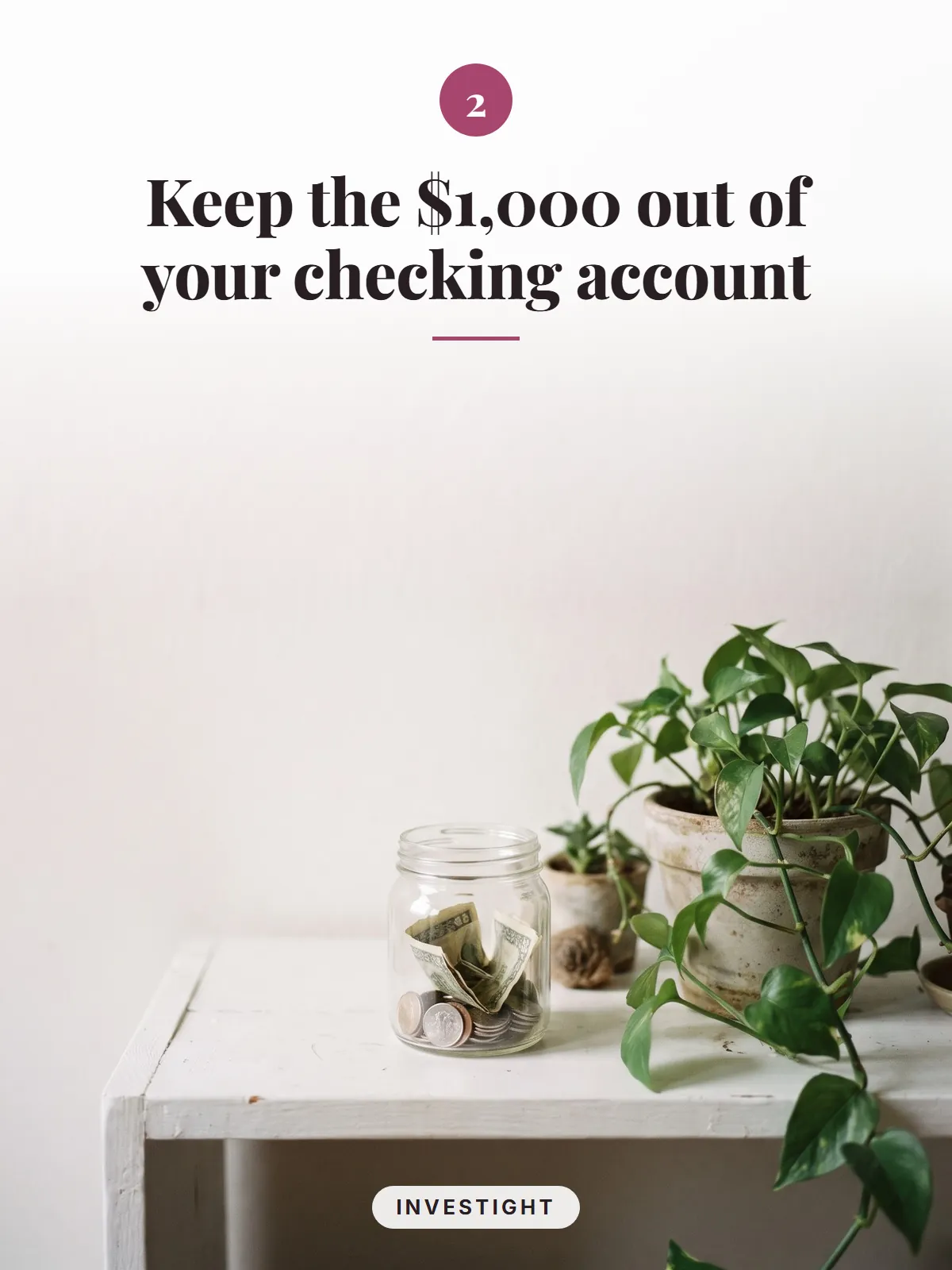
Name the account after the goal, like "Emergency fund" or "Car repairs". A named account is surprisingly hard to raid.
Step 4: Automate the First Deposit
Set an automatic transfer for your chosen amount on payday. Automation is the single biggest reason people finish a savings challenge, because the money moves before it can be spent.
If your income changes from week to week, set the transfer to the smallest amount you are sure you can afford, and add extra by hand on good weeks.
For a bigger challenge after this one, our 100 envelope challenge uses the same habit to reach $5,050.
Step 5: Color Your Tracker Every Time
Print the tracker for your plan and keep it where you see it daily: the fridge, a planner or the bathroom mirror. Color a box the same day the money moves.
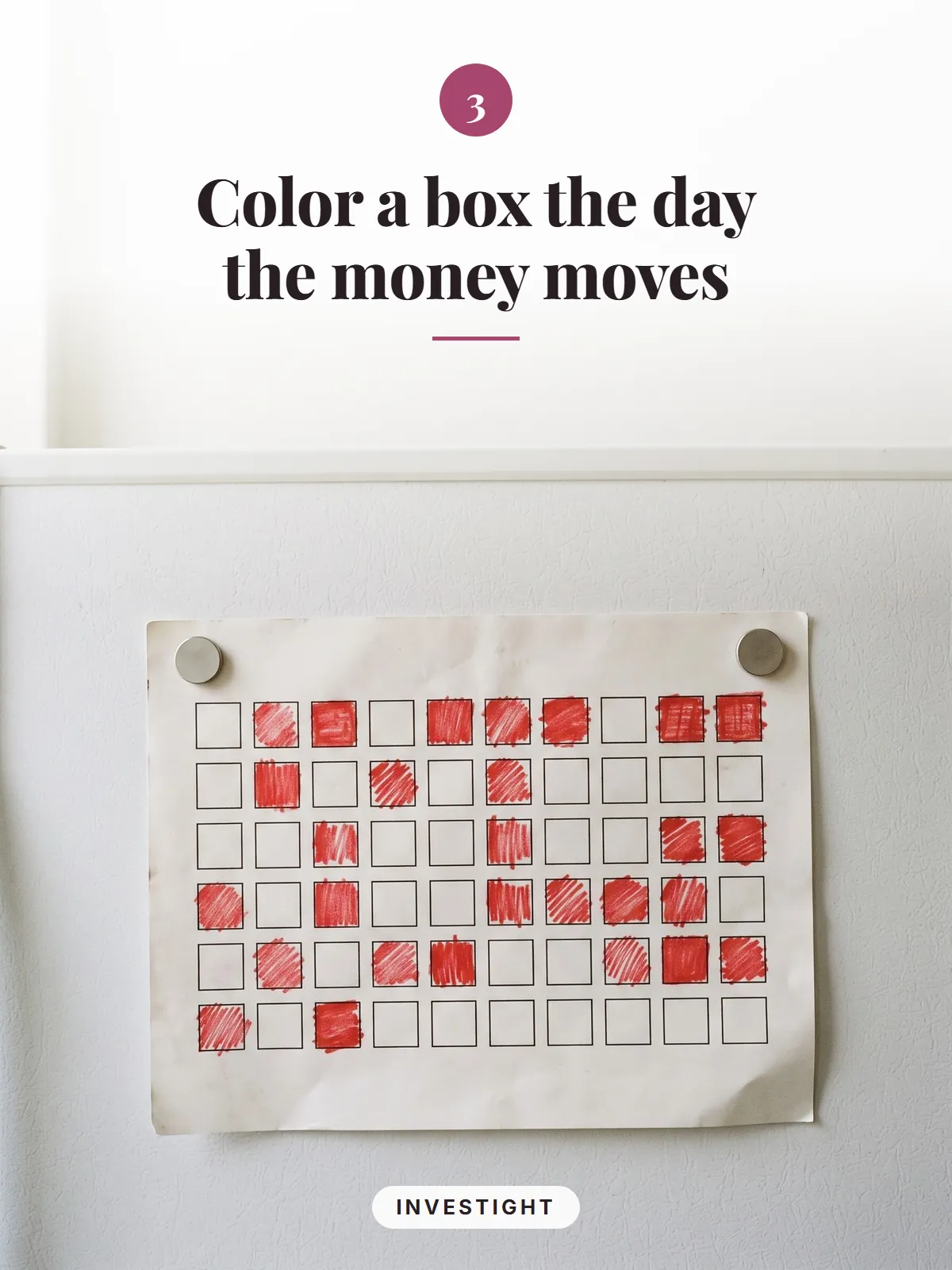
Seeing your savings tracker fill up is what carries you through the middle of the challenge, when the excitement of the start has faded and the finish still feels far away.
Step 6: Boost It When You Can
Any extra money speeds up the challenge: a tax refund, a rebate, birthday money or a small bonus. Send at least half of every windfall straight to your challenge and color the matching boxes.

On tight weeks, keep the habit alive with a smaller deposit. Saving $5 in a hard week keeps you in the game far better than skipping.
The 30-Day $1000 Savings Challenge
The 30-day version is the most popular $1000 savings challenge on Pinterest, and also the hardest. It works best when you combine three things at once: cutting spending, earning a little extra and selling things you no longer need.
Here is one realistic mix for a single month. Pause takeout and coffee runs for a total of about $200. Cancel or pause two subscriptions for $30. Plan meals from your pantry for $150 less on groceries. Sell three to five unused items for about $250.
That reaches $630. The remaining $370 usually comes from extra income: a few overtime shifts, weekend pet sitting, babysitting or a short side hustle. If you cannot find it, stretch the challenge to 60 days. You still reach $1,000, and you keep your sanity.
The 3-Month and 6-Month Plans
The 3-month plan needs $76.92 a week. That is about $333 a month, which most households can reach with a few steady cuts and one small boost each month.
The 6-month plan needs $38.46 a week, or about $167 a month. It is the sweet spot for many beginners: noticeable progress every week, but no major sacrifice.
Both plans fit nicely around a season. Start in January and finish before summer travel, or start in June and have a $1,000 cushion before the holidays.
The Biweekly $1000 Savings Challenge
If you are paid every two weeks, save on payday instead of weekly. Twenty-six paychecks at $38.46 each reach $1,000 in a year.
Want it faster? Thirteen paychecks at $76.93 reach $1,000 in six months, and seven paychecks at $142.86 reach it in about three months.
Some months bring a third paycheck, which happens twice a year for biweekly pay. Use those two extra paychecks to color several boxes at once and finish early.
The Small-Amounts Version for Tight Budgets
If $19 or $38 at a time feels impossible right now, the small-amounts tracker below is for you. It has 80 boxes from $5 to $20, and you color whichever box fits your week.
On a lean week, color a $5 box. After a good week, color a $20 box. There is no schedule to fall behind on, and every box counts toward the same $1,000.
Low-income budgets often find money in small, recurring places: a cheaper phone plan, one canceled streaming service, store-brand groceries or a round-up feature that moves spare change to savings. Each of those can color one or two boxes every month.
Where to Find Money for the Challenge
Most people do not find $1,000 in one place. They find $20 here and $50 there until the boxes are full. These are the most reliable sources.
Subscriptions: review your bank statement and cancel anything you have not used in a month. Many households find $20 to $50 a month.
Groceries: plan meals for the week before you shop and use what you already have. A pantry week can save $50 to $100.
Phone and insurance: call your provider and ask for a lower rate, or compare quotes. A single call can save $20 to $40 a month.
Selling things: clothes, toys, tools and small furniture you no longer use. Many people raise $100 to $300 in a weekend.
Extra income: overtime, a weekend shift, pet sitting, tutoring or freelance work. Even a few hours a month can fill several boxes.
Doing the Challenge as a Couple or a Family
Two people can split a $1000 savings challenge and finish twice as fast. If each partner saves $19.23 a week, you reach $1,000 in six months instead of a year.
If your incomes are very different, split by percentage instead of 50/50. One partner might color three boxes for every two the other colors. What matters is that you share one tracker and one goal.
Kids can run a mini version beside yours. Give them a $50 or $100 tracker with $1 and $2 boxes, and let them fill it with chores or birthday money. Saving side by side turns the challenge into a family project, and children learn the habit by watching you.
What to Do if You Fall Behind
Almost everyone misses a deposit at some point. A surprise bill, a short paycheck or a busy month can throw off the plan. The fix is simple: adjust, do not restart.
If you miss one week, add that amount to the next payday or spread it over the next four weeks. If you miss several weeks, extend the end date instead of trying to catch up all at once.
Switching to the small-amounts tracker is another option. Every dollar you already saved still counts, and the flexible boxes let you keep going without a fixed schedule hanging over you.
Use the Challenge to Pay Off a Small Debt
A $1000 savings challenge works just as well in reverse. If you have a small credit card balance or a medical bill under $1,000, use the tracker to pay it off instead.
Each time you make an extra payment, color the matching boxes. Paying off a card that charges more than 20% interest is one of the best returns you can get on $1,000, and the tracker keeps you motivated the same way.
Once the debt is gone, start the challenge again, this time for savings. The weekly amount you were paying is already built into your budget. For more trackers like these, browse our savings challenges.
Why $1,000 Is the Right First Goal
A $1,000 starter emergency fund changes how surprises feel. Without it, a flat tire or a broken phone goes on a credit card and may cost interest for months. With it, the surprise is just an expense.
Small savings goals also build the habit faster. Reaching $1,000 in a few months teaches you that you can save, and that confidence carries over into bigger goals like a full emergency fund of three to six months of expenses.
Once you reach $1,000, keep it as your cushion and start a second challenge for the next goal. Many people move straight to a $5,000 or $10,000 plan using the same weekly habit.
How Much Interest Your $1,000 Can Earn
Keeping the money in a high-yield savings account adds a little bonus. At an example rate of 3.5% APY, $1,000 earns about $35 in a year once it is fully saved. During a one-year challenge, while the balance grows from $0, it earns roughly half that.
That will not change your life, but it pays for a box or two on your tracker. Cash in a jar at home earns nothing and is not protected if it is lost or stolen. Rates change often, so check your bank's current rate.
Ways to Make the Challenge More Fun
Saving is easier when it feels like a game. Use a different color for each month on your tracker, so you can see your pace at a glance and spot the months where you saved the most.
Set small rewards at 25%, 50% and 75% of the goal. Keep them low cost, like a picnic, a movie night at home or a favorite meal you cook yourself.
Invite a friend to run the same challenge and compare trackers every Sunday. A little friendly competition keeps both of you going, and it gives you someone to talk to on the weeks when saving feels hard.
$1000 Savings Challenge Mistakes to Avoid
Picking the fastest plan by default. A 30-day plan that fails on day 8 saves less than a 6-month plan you finish. Choose the pace your budget can carry.
Keeping the money in checking. Savings mixed with everyday money slowly disappear. A separate account is the easiest fix.
Restarting after a missed week. You do not have to start over. Add the missed amount to the next good week, or extend the end date by one week.
Not naming the goal. Write what the $1,000 is for at the top of your tracker. A clear purpose is what keeps you from raiding it in week 9.
Frequently Asked Questions
How can I save $1,000 in 30 days?
Combine cuts and extra income: pause takeout and subscriptions, plan meals from your pantry, sell unused items and add a few hours of extra work. Saving $1,000 in 30 days means about $33.34 a day.
How much should I save each paycheck to reach $1,000?
If you are paid every two weeks, $38.46 per paycheck reaches $1,000 in a year, and $76.93 per paycheck reaches it in six months.
What is the easiest $1000 savings challenge?
The small-amounts tracker, where you color any $5 to $20 box that fits your week. It has no schedule, so a tight week never puts you behind.
Where should I keep my $1,000?
In a separate savings account, ideally a high-yield one at an insured bank or credit union. Name it after the goal so you are less tempted to spend it.
What should I do after saving $1,000?
Keep it as a starter emergency fund, then start a new challenge for the next goal, such as a full emergency fund, paying off a credit card or a $5,000 savings plan.
Is $1,000 enough for an emergency fund?
It is a strong starter fund that covers many common surprises. Over time, aim for three to six months of essential expenses for a full emergency fund.
Can I do a $1000 savings challenge on a low income?
Yes. Choose the one-year plan at $19.23 a week, or the small-amounts tracker where you color any $5 to $20 box. Small recurring cuts, like a cheaper phone plan, can fill several boxes a month.
Should I save $1,000 or pay off debt first?
Many people do both in order: build a $1,000 starter cushion first so surprises do not go on a card, then focus on high-interest debt. If you already have some savings, a high-interest card is usually the better target.
How long does it take to save $1,000?
It depends on the amount you can save. At $19.23 a week it takes a year, at $38.46 a week six months, at $76.92 a week three months, and at about $33 a day one month.
Color Your First Box This Week
You do not need a perfect month to start. Pick the plan that fits your pay, set up one automatic transfer and print your tracker.
Then color the first box. A $1000 savings challenge is really a habit challenge, and every box you color makes the next one easier.

Pin this guide to your money board
Save this saving money guide on Pinterest so the numbers and checklist are there when you need them.
Save on PinterestThis guide is general education, not individualized financial, tax, or investment advice. Figures reflect rules in effect on Nov 20, 2026. See our financial disclaimer.
