

The debt snowball is a debt payoff method where you list your debts from the smallest balance to the largest, pay the minimum on everything and put every extra dollar toward the smallest debt. When it is gone, you roll its payment into the next smallest. Each payment grows like a snowball rolling downhill.
Learn how the debt snowball works in 6 steps, with a real $14,250 example paid off in 21 months, a comparison with the avalanche and a printable worksheet.
The snowball works because of quick wins. Paying off a small debt in the first month or two proves the plan works, which keeps you going through the long middle.
Below are six steps, a real example where $14,250 of debt is paid off in 21 months, how the snowball compares with the avalanche and a printable worksheet.
This is general education, not personalized financial advice.
Table of Contents 28 sections
Debt Snowball Example: Payoff Order
Four debts, $506 in minimums plus $250 extra each month.
| Debt | Balance | APR | Minimum | Paid Off In |
|---|---|---|---|---|
| Medical bill | $450 | 0% | $50 | Month 2 |
| Store card | $1,100 | 24.99% | $35 | Month 5 |
| Credit card | $4,200 | 21.99% | $126 | Month 15 |
| Car loan | $8,500 | 6.9% | $295 | Month 21 |
Step 1: List Every Debt From Smallest to Largest
Write down every debt except your mortgage: credit cards, store cards, medical bills, personal loans, car loans and student loans. Sort them by balance, from smallest to largest, ignoring interest rates.

Step 2: Pay the Minimum on Everything
Set up minimum payments on every debt, ideally with autopay, so nothing is late. Late fees and missed payments slow the snowball and hurt your credit.
Step 3: Find Your Extra Payment
Look at your budget for money you can redirect to debt: a canceled subscription, fewer takeout nights, a cheaper phone plan or a side income. In the example, the extra is $250 a month.

Step 4: Attack the Smallest Debt
Send every extra dollar to the smallest debt while paying minimums on the rest. In the example, the $450 medical bill gets $300 a month ($50 minimum plus $250 extra) and is gone in month 2.
Step 5: Roll the Payment Into the Next Debt
When a debt is paid off, add its full payment to the next smallest debt. In the example, the medical bill's $300 joins the store card's $35 minimum, so the store card gets $335 a month and is gone by month 5.
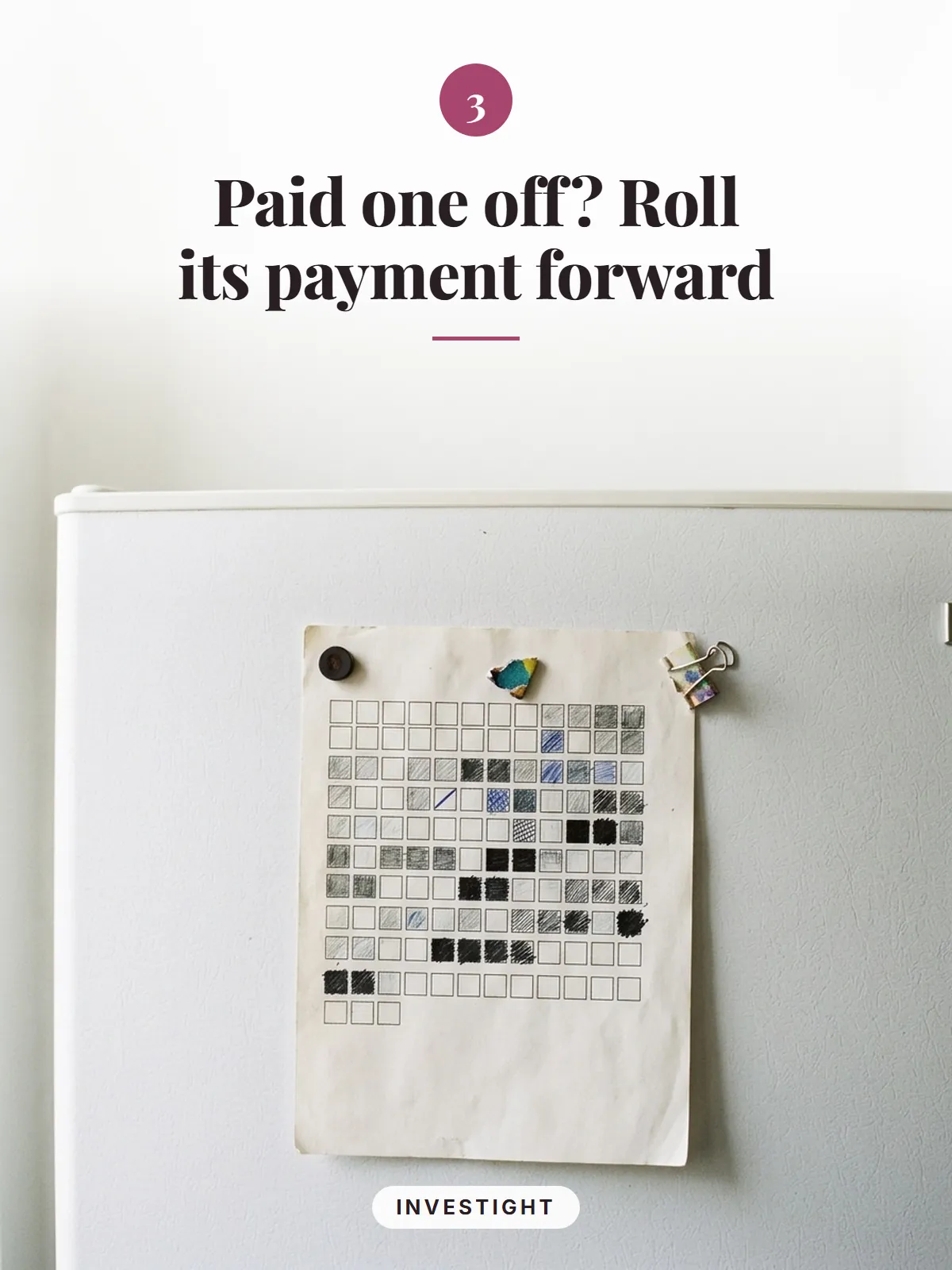
Then the store card's $335 rolls onto the credit card, which gets $461 a month and is paid off by month 15. Finally, everything goes to the car loan, which is gone in month 21.
Step 6: Track Progress and Celebrate
Update a tracker every month and cross off each debt as it disappears. Celebrate each payoff with something small and low cost. Those milestones are the fuel of the snowball method.
The Example in Numbers
With $756 a month going to debt ($506 in minimums plus $250 extra), the four debts totaling $14,250 are paid off in 21 months, with about $1,504 in total interest.
Without the extra $250, even rolling each freed payment forward, the same debts take 35 months and cost about $3,097 in interest. The extra $250 a month saves 14 months and about $1,590.
Debt Snowball vs Debt Avalanche
The debt avalanche pays the highest interest rate first instead of the smallest balance. With the same debts and the same $250 extra, the avalanche also finishes in 21 months, with about $1,462 in interest.
That is only about $42 less than the snowball. In this example, the smallest debts also carry high rates or no interest, so both methods follow almost the same path.
When a large debt has a much higher rate than smaller ones, the avalanche can save more. If quick wins keep you motivated, the snowball is still a strong choice. The best method is the one you stick with.
Why the Debt Snowball Works for So Many People
Debt payoff is as much about behavior as math. Paying off a whole debt early gives a sense of progress that a slowly shrinking balance cannot.
Fewer bills also simplify life. Each paid-off debt is one less due date, one less statement and one less thing to worry about. That simplicity helps people stick with the plan for months or years.
Where the Debt Snowball Comes From
Paying debts smallest balance first is an old idea, but it became widely known through personal finance author and radio host Dave Ramsey, who made the debt snowball a central step in his popular plan for getting out of debt.
The idea has also been studied by researchers who look at how people stay motivated. The common finding is simple: visible wins help people keep going. That is the core strength of the snowball.
Using the Debt Snowball for Credit Card Debt
Many people use the snowball mainly for credit card debt. List every card by balance, smallest first, and attack the smallest while paying minimums on the rest.
Because credit cards often carry high interest, also call each issuer to ask for a lower rate, and consider whether a balance transfer with a 0% promotional rate would help. Any interest you avoid makes the snowball move faster.
Most important: stop adding new charges. A snowball cannot grow if card balances keep rising.
Medical Debt in the Snowball
Medical debt often carries little or no interest, especially when you set up a payment plan with the provider. In the example, the medical bill had 0% interest and the smallest balance, so it came first.
Before paying a large medical bill, ask for an itemized bill, check for errors and ask about financial assistance or discounts for paying in full. Many hospitals have assistance programs for patients who qualify. Lowering a medical bill before it enters the snowball can shorten the whole plan.
Student Loans and the Snowball
Student loans often have large balances and lower interest rates, so they usually come last in the snowball. Federal student loans may also offer income-driven repayment, deferment or forgiveness options that are worth checking before paying them off aggressively.
Keep making required payments on time, and let the snowball reach your student loans once your smaller consumer debts are gone.
The Debt Snowball on a Tight Budget
If you have very little extra money, start the snowball with whatever you can find, even $25 a month. The smallest debt will still disappear sooner, and every freed payment adds to the next one.
Look for small, steady sources of extra money: selling unused items, an occasional side job or part of a tax refund. Avoid new debt above all, and call creditors to ask about hardship programs if minimums are a struggle.
Doing the Debt Snowball as a Couple
List both partners' debts on one worksheet and agree on the order together. Decide how much extra you will send each month and from which paychecks.
Celebrate each paid-off debt together. Shared wins make the plan feel like teamwork, and talking about progress once a month keeps both partners committed.
How to Stay Motivated Through the Middle
The first one or two debts disappear quickly. The middle debts, often larger credit cards or loans, take longer and can feel endless.
Keep a visible tracker on the fridge and update it monthly. Break large debts into milestones, like every $1,000 paid, and celebrate each one. Remind yourself that your snowball payment is now much bigger than when you started.
A Month-by-Month Look at the Snowball
Here is how the payment grows in the example, with $756 a month going to debt in total.
| Months | Debt Being Attacked | Payment on That Debt |
|---|---|---|
| 1 to 2 | Medical bill | $300 |
| 3 to 5 | Store card | $335 |
| 6 to 15 | Credit card | $461 |
| 16 to 21 | Car loan | $756 |
Notice how the payment on each target debt grows: from $300 to $756 a month by the end. That growth is the snowball. The car loan, the largest debt, disappears in just six months once the full payment reaches it.
How to Find More Money for the Snowball
The bigger your extra payment, the faster the snowball rolls. Look at your three biggest flexible expenses, usually food, transportation and shopping, and find one change in each.
Common sources: meal planning to cut takeout, a cheaper phone or insurance plan, pausing subscriptions, selling unused items, overtime or a few hours of side income. Send every windfall, like a tax refund or bonus, straight to the current target debt.
Even an extra $50 a month can shave months off a plan, because it keeps compounding as the snowball grows.
What to Do When the Snowball Is Done
When your last debt is paid off, you suddenly have a large monthly amount available. In the example, that is $756 a month. Decide its next job right away.
A common order: grow your emergency fund to three to six months of expenses, increase retirement savings and then save for big purchases in cash so you do not need to borrow again.
Keep the habits that worked: a monthly budget, automatic transfers and a habit of paying cards in full.
How the Snowball Affects Your Credit Score
Paying down balances, especially on credit cards, often helps your credit score over time, because it lowers how much of your available credit you are using. Paying every bill on time, which the snowball encourages, matters even more.
Think twice before closing paid-off cards. An old account with no balance can help your credit history and utilization. If a card tempts you to spend or charges an annual fee, closing it may still be the better choice.
Tools for Tracking Your Snowball
A printed worksheet on the fridge, a simple spreadsheet or a debt payoff app can all work. What matters is updating it once a month and seeing the total fall.
Many people like to pair a detailed log with a visual tracker, like a thermometer or a chart of boxes to color for every $100 paid. Seeing progress at a glance keeps motivation high.
Debt Snowball Rules of Thumb
Keep debts in order by balance, but if two balances are close, pay the higher-rate one first. Always pay minimums on time. Send windfalls to the current target debt.
Never let a freed payment slip back into everyday spending. And if a new emergency appears, pause the extra payment, use your emergency fund and restart the snowball as soon as you can.
Is the Debt Snowball Right for You?
The snowball is a great fit if you have several small debts, feel overwhelmed by the number of bills or have struggled to stay motivated with past plans. Early wins make it easier to keep going.
If one large debt has a much higher interest rate than the rest, the avalanche may save meaningfully more. You can also mix the two: knock out one or two tiny debts first for momentum, then switch to highest rate first.
What to Do Before You Start the Snowball
Build a small emergency fund first, often $500 to $1,000, so a surprise expense does not go back on a card. Stop using credit cards while you pay them down.
Make a simple monthly budget so you know your extra payment is realistic. If minimums are more than you can manage, contact your creditors about hardship options or a nonprofit credit counselor before starting.
Debt Snowball Mistakes to Avoid
Not stopping new debt. A snowball cannot grow if new balances keep appearing.
Skipping the emergency fund. Without it, the first surprise goes on a card.
Spreading extra money across all debts. Focus on one debt at a time.
Letting freed payments disappear. When a debt is paid off, move its payment to the next debt the same month. For more tools, see our debt payoff tracker and our debt payoff guides.

Frequently Asked Questions
How does the debt snowball method work?
You list debts from smallest to largest balance, pay minimums on all of them and put every extra dollar on the smallest. When it is paid off, its payment rolls into the next smallest debt.
Is the debt snowball or avalanche better?
The avalanche usually saves a little more interest, while the snowball gives faster wins. In our example, the difference was about $42. Choose the method you will stick with.
Should I include my mortgage in the debt snowball?
Most people leave the mortgage out and focus on consumer debts like credit cards, car loans and medical bills.
How long does the debt snowball take?
It depends on your debts and extra payment. In our example, $14,250 was paid off in 21 months with $250 a month extra, compared with 35 months without it.
Do I need an emergency fund before the debt snowball?
A small one helps, often $500 to $1,000, so surprises do not add new debt while you pay off old balances.
What if two debts have similar balances?
Many people pay the one with the higher interest rate first in that case. It keeps the snowball spirit while saving a little more interest.
Can I use the debt snowball for student loans?
Yes, but they usually come last because of their large balances. Check federal repayment options first, and keep paying on time while the snowball handles smaller debts.
What if I get a raise during the debt snowball?
Send most or all of the raise to your current target debt. Because your budget already works without it, the raise can speed up the snowball without changing your lifestyle.
Should I pause retirement savings for the debt snowball?
Many people keep contributing at least enough to get any employer match, since that is part of their pay. Beyond that, how much to pause is a personal choice.
What happens if I have an emergency during the snowball?
Use your emergency fund, pause the extra payment if needed and restart the snowball once the emergency is covered. Keep paying minimums on every debt.
Does the debt snowball work for large debts?
Yes. Large debts usually come last, and by the time the snowball reaches them, the payment is much bigger, which makes them disappear faster than you might expect.
How do I keep from adding new debt during the snowball?
Remove cards from your wallet and online accounts, build a small emergency fund and use sinking funds for predictable costs like car repairs and holidays.
Start Your Debt Snowball This Month
List your debts tonight, smallest to largest. Find one extra payment, even $50, and send it to the smallest debt this month.
Then let the snowball grow. Every debt you pay off makes the next one disappear faster, and the debt snowball turns slow progress into momentum you can see.

Pin this guide to your money board
Save this budgeting guide on Pinterest so the numbers and checklist are there when you need them.
Save on PinterestThis guide is general education, not individualized financial, tax, or investment advice. Figures reflect rules in effect on Nov 21, 2026. See our financial disclaimer.
