

Here is how to pay off debt quickly: list every debt, stop adding new debt, pay the minimums on everything and send every extra dollar to one debt at a time, starting with the highest interest rate.
Learn how to pay off debt quickly in 9 steps, with a real example paying off $23,000 in 25 months instead of 40 by adding $300 a month to the right debt.
When it is gone, roll that payment into the next. Lower your rates where you can, and find extra money through cuts and side income.
The math matters. In the example below, a household with $23,000 of debt pays it off in 40 months with minimum payments rolled forward. Adding $300 a month cuts that to 25 months and saves about $3,200 in interest.
Below are nine steps, the full example, the avalanche and snowball compared, and when consolidation or credit counseling makes sense.
This is general education, not personalized financial advice. Rates, fees and offers vary, so read every agreement carefully.
Table of Contents 25 sections
How Extra Payments Speed Up Debt Payoff
Example: $23,000 across four debts with $750 a month in minimum payments, paid highest rate first.
| Extra Each Month | Debt-Free In | Total Interest |
|---|---|---|
| $0 (freed payments rolled forward) | 40 months | About $6,441 |
| $300 | 25 months | About $3,211 |
| $600 | 19 months | About $2,258 |
Step 1: List Every Debt With Its Rate
Write down every balance you owe: credit cards, personal loans, car loans, student loans, medical bills and buy now, pay later plans. For each one, note the balance, interest rate (APR), minimum payment and due date.
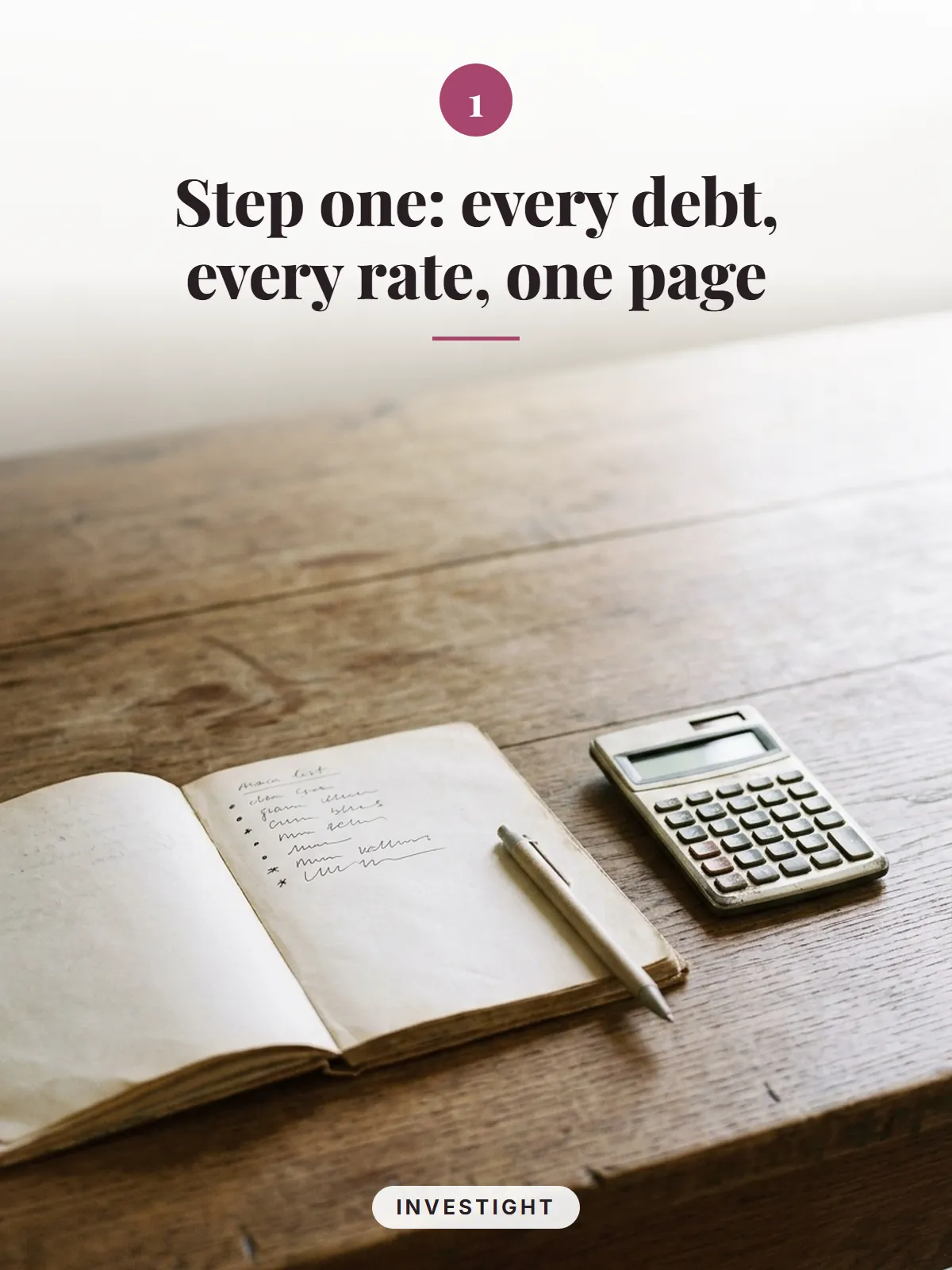
Use your latest statements, not memory. Seeing the full picture is uncomfortable, but it is the only way to make a plan that works.
Step 2: Stop Adding New Debt
You cannot dig out of a hole while you keep digging. Take the cards you are paying off out of your wallet, remove them from shopping sites and pause buy now, pay later purchases.
If you are using credit to cover everyday bills, that is a sign the budget needs attention first. The next steps help with that.
Step 3: Build a Small Emergency Cushion
It sounds backward, but a $500 to $1,000 cushion helps you pay off debt faster. Without it, the next flat tire or doctor visit goes right back on a card and undoes months of progress.
Build it quickly by selling unused items or pausing extras for a few weeks, then turn your attention fully to debt.
Step 4: Make a Budget That Finds Extra Money
Write a simple monthly budget with every bill, minimum payment and spending category. Then look for money you can redirect to debt: subscriptions, takeout, a cheaper phone plan or lower insurance.

Even $100 or $200 a month makes a real difference, as the example shows. The goal is one steady extra payment you can keep up.
Step 5: Choose Avalanche or Snowball
With the debt avalanche, you pay extra on the highest interest rate first. It costs the least in interest and is usually the fastest.
With the debt snowball, you pay extra on the smallest balance first. Quick wins keep many people motivated. Either works if you stick with it.
Our debt payoff tracker has printable worksheets for both methods.
Step 6: Pay Minimums on Everything, Extra on One
Pay the minimum on every debt to avoid late fees and protect your credit. Then send every extra dollar to the one debt at the top of your list.
Focusing on one debt is what makes progress visible. Spreading extra money thinly across all debts feels busy but slows everything down.
Step 7: Lower Your Interest Rates
Call your credit card companies and ask for a lower rate, especially if you have a good payment history. It does not always work, but it costs nothing to ask.
If your credit is good, a 0% balance transfer card or a lower-rate personal loan can cut interest. Watch for transfer fees, usually a few percent of the balance, and make sure you can pay the balance before any promotional rate ends.
Step 8: Add Income and Send It All to Debt
A side hustle, overtime or a raise can speed things up dramatically. Send every extra dollar, plus windfalls like tax refunds and bonuses, straight to the debt at the top of your list.
Step 9: Roll Each Payment Into the Next Debt
When the first debt is paid off, add its full payment to the next debt on your list. That rolling payment grows with every debt you clear, which is why the final debts disappear fastest.
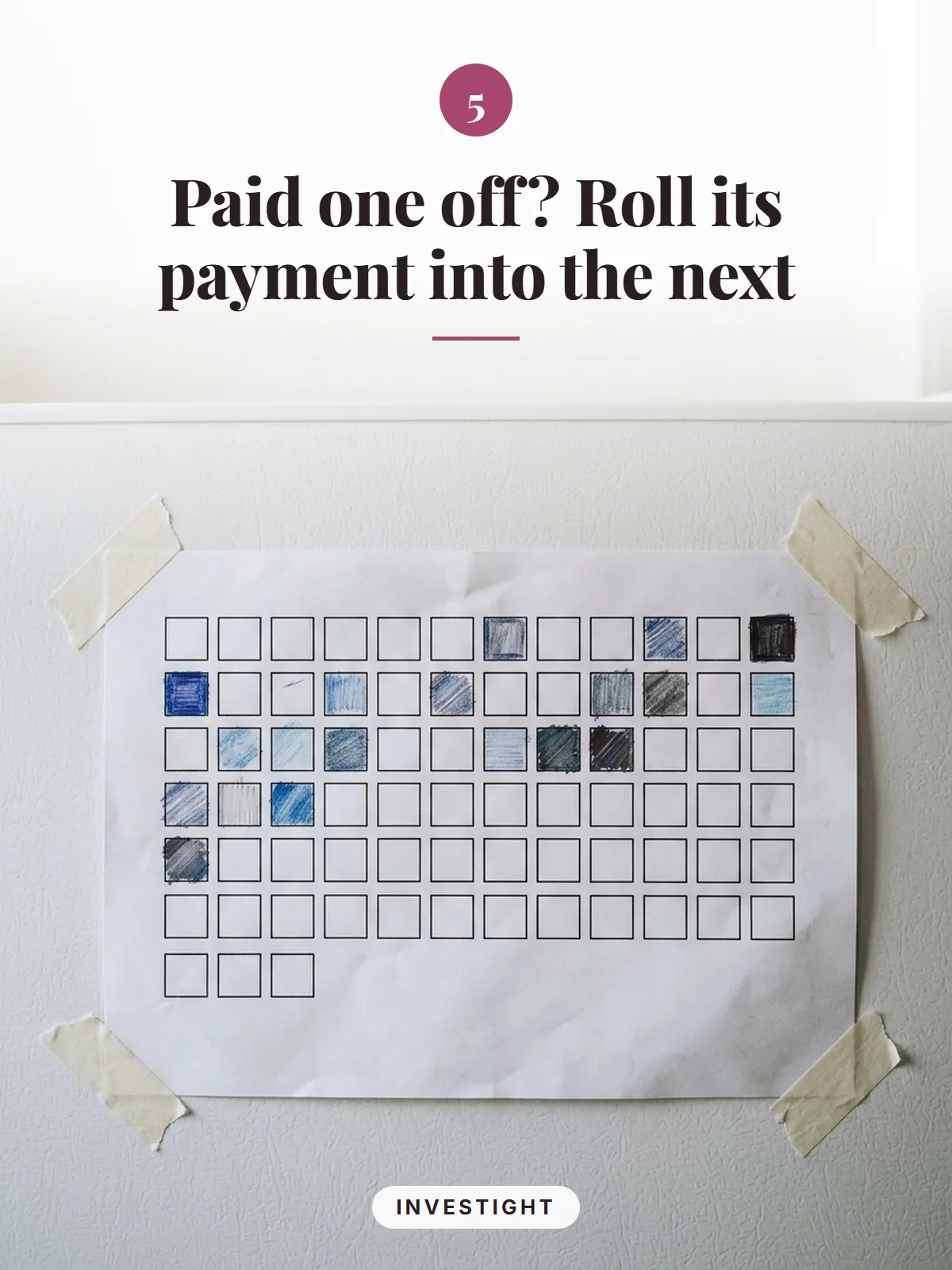
Track your progress every month on a printed tracker. Watching balances fall is the best motivation for the long middle stretch.
The Full Example: $23,000 in 25 Months
Here are the four debts in the example and how the plan plays out with $300 a month extra, using the avalanche order.
| Debt | Balance | APR | Minimum |
|---|---|---|---|
| Card A | $2,400 | 26.99% | $72 |
| Card B | $5,600 | 21.99% | $168 |
| Personal loan | $6,000 | 12% | $200 |
| Car loan | $9,000 | 6.8% | $310 |
With $1,050 a month going to debt ($750 in minimums plus $300 extra), Card A is gone in month 8 and Card B in month 18. The personal loan is paid off in month 23 and the car loan in month 25. Total interest is about $3,211.
Without the extra $300, even rolling each freed payment forward, the same debts take 40 months and cost about $6,441 in interest. The extra $300 a month saves 15 months and about $3,230.
Avalanche vs Snowball: The Real Difference
Using the same debts and the same $300 extra, the snowball method pays the smallest balances first. It finishes in 26 months with about $3,481 in interest.
The avalanche finishes one month sooner and saves about $270. That is a real but modest difference. If the early win of clearing a small balance keeps you going, the snowball is a perfectly good choice.
The gap grows when a large balance has a much higher rate than the others. In that case, the avalanche can save far more.
A Debt Payoff Budget Example
Here is how the household in the example finds $300 a month on $4,600 of take-home pay without a second job.
| Change | Monthly Amount |
|---|---|
| Meal planning and fewer takeout nights | $120 |
| Canceled three subscriptions | $35 |
| Lower phone plan after one call | $30 |
| Paused one hobby and impulse shopping | $65 |
| Weekend pet sitting, two visits | $50 |
| Total extra for debt | $300 |
None of these changes is extreme. Together, they cut 15 months off the debt and save more than $3,000 in interest. When a raise or refund arrives, that money goes to debt too, which shortens the timeline even more.
Why Credit Card Debt Should Usually Come First
Credit card debt often carries interest rates above 20%, much higher than most car loans and many student loans. Every dollar of extra payment on a high-rate card saves more interest than the same dollar on a low-rate loan.
That is why the avalanche puts cards first in most plans. Federal student loans can also have income-driven repayment options and other protections, so check your options before choosing to pay them aggressively ahead of higher-rate debt.
Paying Off Debt as a Couple
If you share finances, agree on the plan together: which debts are joint, which method you will use and how much extra goes to debt each month. Keep one shared tracker and review it during a short money check-in each month.
If one partner brought more debt into the relationship, talk openly about how you will handle it. Many couples treat all debt as a shared goal, while others keep some debts separate. What matters is that you both know the plan.
How to Stay Motivated Until the Last Payment
Debt payoff takes months or years, and the middle is the hardest part. Break the goal into milestones: each paid-off debt and each $5,000 reduction deserves a small, low-cost celebration.
Use a visual tracker on the fridge and update it on the same day every month. Read your list of reasons, like less stress, more savings or a family goal, when you feel like giving up. And remember that each month the interest shrinks, so more of every payment goes to the balance.
When Debt Consolidation Makes Sense
A consolidation loan combines several debts into one loan, ideally at a lower rate. It can lower your interest and simplify payments, but only if you stop using the paid-off cards.
Compare the new rate, any origination fees and the loan term. A longer term can lower the monthly payment but increase total interest. Consolidation works best for people with steady income, decent credit and a plan to avoid new debt.
When to Get Help From a Nonprofit Credit Counselor
If minimum payments are more than you can manage, consider a nonprofit credit counseling agency. Counselors can review your budget and may offer a debt management plan, where they work with creditors to lower interest rates and combine payments into one.
Look for agencies affiliated with recognized nonprofit networks, and be cautious of companies that charge large upfront fees or promise to settle debts for pennies on the dollar. Debt settlement can seriously damage your credit and may come with tax consequences.
How to Pay Off Debt Quickly on a Low Income
On a tight budget, the biggest wins are often avoiding fees and lowering rates. Set up autopay for minimums, call creditors to ask about hardship programs and ask for lower interest rates.
Sell what you can, look for assistance programs that lower bills like internet or utilities, and put every small windfall toward the highest-rate debt. Progress may be slower, but it still counts. You can find more plans like this in our debt payoff guides.
What to Do After You Pay Off Your Debt
The month after your last payment, you suddenly have a large amount of money that used to go to debt. In the example, that is $1,050 a month. Decide its new job before the final payment, or it will slip into everyday spending.
A common order: grow your emergency fund to three to six months of expenses, raise retirement contributions, then save for big purchases in cash so you never need to borrow for them again.
Keep using the habits that got you out of debt: a monthly budget, a short list of savings goals and a rule of thinking twice before any new loan or card balance.
How Paying Off Debt Affects Your Credit
Paying down balances, especially on credit cards, often helps your credit score over time because it lowers how much of your available credit you use. Paying every bill on time matters even more.
Be careful about closing paid-off cards. An old card with no balance can help your credit history and utilization. If a card has an annual fee or tempts you to spend, closing it may still be the right choice for you.
Debt Payoff Mistakes to Avoid
Paying only minimums. Minimums keep you in debt for years. Even a small extra payment changes the timeline.
Closing every card right away. Closing old accounts can affect your credit utilization and history. Many people keep old cards open with no balance instead.
Using savings for everything. Keep a small emergency fund so new surprises do not become new debt.
Giving up after a setback. A surprise expense is not failure. Update your plan and keep going next month.
Pay Off Debt Quickly Checklist
Work through these steps this month.
- List every debt with balance, APR and minimum
- Remove saved cards from shopping sites
- Build a $500 to $1,000 cushion
- Find one extra monthly payment in your budget
- Choose avalanche or snowball and number your debts
- Call each card company to ask for a lower rate
- Send every windfall to the top debt
- Update your tracker every month
Frequently Asked Questions
What is the fastest way to pay off debt?
Pay minimums on everything and send every extra dollar to the debt with the highest interest rate, rolling each paid-off payment into the next debt. Adding income and lowering rates speeds it up further.
Is the snowball or avalanche method faster?
The avalanche usually finishes slightly faster and costs less interest. In our example, it finished one month sooner and saved about $270. The snowball gives earlier wins, which helps many people stay motivated.
How much extra should I pay on debt each month?
Any extra amount helps. In our example, $300 a month extra cut the payoff time from 40 months to 25 and saved about $3,200 in interest.
Should I use savings to pay off debt?
Keep a small emergency fund of $500 to $1,000 first. Beyond that, using extra savings to pay off high-interest debt often makes sense, because the interest you avoid is usually higher than what savings earn.
Is debt consolidation a good idea?
It can be if the new loan has a lower rate, reasonable fees and you stop using the old cards. A longer term can lower payments but raise total interest.
What if I cannot afford my minimum payments?
Contact your creditors about hardship programs and consider a nonprofit credit counseling agency, which may offer a debt management plan with lower rates.
How long does it take to pay off $20,000 in debt?
It depends on interest rates and how much you pay. In our example, about $23,000 across four debts took 25 months with $1,050 a month going to debt, and 40 months with only $750 a month.
Should I pay off debt or invest?
Many people do both in a set order: get any employer retirement match first, then focus on high-interest debt like credit cards, then increase investing once that debt is gone. Low-interest debt can often be paid on schedule while you invest.
Does a debt management plan hurt my credit?
Enrolling in a plan through a nonprofit agency is not the same as settlement. Your cards may be closed, which can affect your score for a while, but steady on-time payments usually help over time.
Can I negotiate my debt myself?
Yes. You can call creditors to ask for a lower rate, a hardship program or a payment plan. Be polite, explain your situation and get any agreement in writing.
What debts should I not pay off early?
Low-interest debt, like some mortgages or car loans under a few percent, is often fine to pay on schedule while you build savings or pay off higher-rate debt first. Check for prepayment penalties on any loan.
Start Your Debt Payoff Plan Today
You do not need a perfect month to begin. List your debts tonight, choose your method and find one extra payment, even $50.
Then repeat it every month and roll each paid-off payment forward. That is really how to pay off debt quickly: one focused debt at a time, with every extra dollar pointed in the same direction.

Pin this guide to your money board
Save this budgeting guide on Pinterest so the numbers and checklist are there when you need them.
Save on PinterestThis guide is general education, not individualized financial, tax, or investment advice. Figures reflect rules in effect on Nov 21, 2026. See our financial disclaimer.
