

Here is how to save money for a house: first set a full target that covers your down payment, closing costs, moving costs and a cash cushion.
Learn how to save money for a house in 9 steps: set your down payment and closing cost goal, pick a monthly amount and use a printable house fund tracker.
Divide it by the months until you want to buy, automate that amount into a high-yield savings account, and speed it up by cutting your biggest expenses and adding income. On a $300,000 home, a realistic first goal is often $20,000 to $30,000.
Many first-time buyers think they need 20% down. Many loans allow much less, which changes the math a lot. Below you will find the real numbers for a $300,000 home, a nine-step plan and a printable house fund tracker.
Mortgage rules and programs change, so confirm the details with a lender before you set your final goal.
Table of Contents 22 sections
How Much You Might Need for a $300,000 Home
Down payment options and typical closing costs. Your loan and lender determine the real numbers.
| Down Payment | Amount | Common Loan Type |
|---|---|---|
| 3% | $9,000 | Some conventional first-time buyer loans |
| 3.5% | $10,500 | FHA loan, with a qualifying credit score |
| 10% | $30,000 | Conventional loan |
| 20% | $60,000 | Conventional loan without mortgage insurance |
Step 1: Set Your Full House Fund Goal
Your house fund is more than the down payment. Add four pieces: the down payment, closing costs, moving and setup costs, and a cash cushion for the first months in the home.
Closing costs are often about 2% to 5% of the loan amount. On a $291,000 loan, that is roughly $5,800 to $14,500. Some of it can be negotiated or covered by seller credits, but plan for it in your savings.
A sample goal for a $300,000 home with 3.5% down: $10,500 down payment, about $8,500 in closing costs, $2,000 for moving and setup and $4,000 as a cushion, for a total of $25,000.
Step 2: Check Your Credit Score Early
Your credit score affects which loans you qualify for and the interest rate you pay. A higher score can lower your monthly payment for decades, so it is worth working on while you save.
Get your credit reports, fix any errors, pay every bill on time and lower your credit card balances. Many lenders look closely at credit card use, so keeping balances low relative to limits helps.
Step 3: Turn the Goal Into a Monthly Number
Divide your house fund goal by the number of months until you want to buy. This single number tells you whether your timeline is realistic.
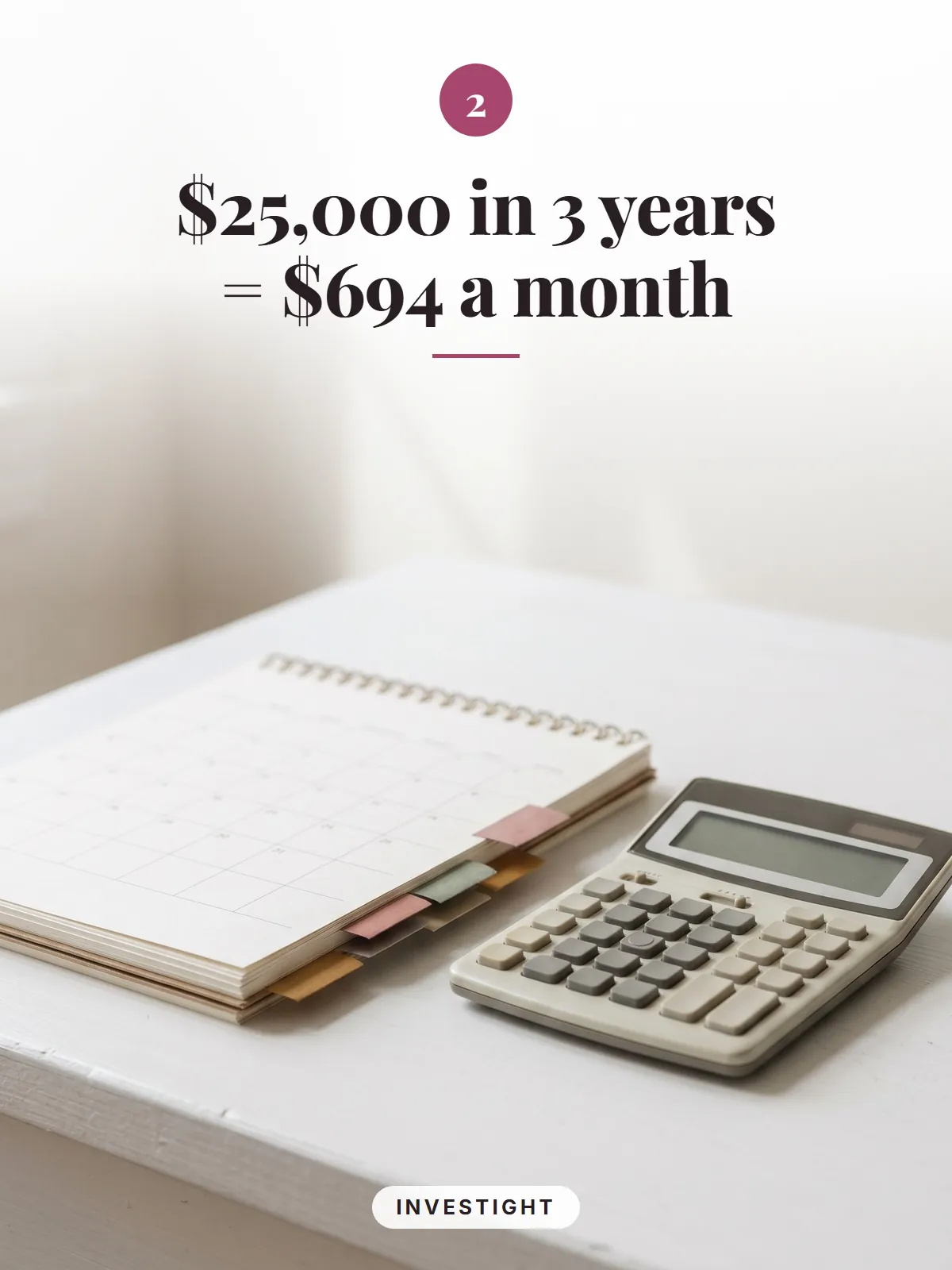
$25,000 in two years is about $1,042 a month. In three years, it is about $694. In four years, about $521. If the monthly number is too high, extend the timeline or look at a lower-priced home.
Step 4: Open a Dedicated House Fund
Keep your house savings in a separate high-yield savings account named for the goal. It earns interest, stays separate from everyday spending and is easy to document when a lender asks to see your funds.
For money you will not need for a year or more, a certificate of deposit (CD) can lock in a rate, but early withdrawal penalties apply. Avoid putting a short-term house fund in stocks, because a market drop right before you buy could set you back months or years.
Step 5: Automate Your Savings on Payday
Set an automatic transfer for your monthly amount, split across paychecks if you are paid every two weeks. Many employers also let you send part of your direct deposit straight to a savings account.
Automation matters more for a house fund than any other goal, because the timeline is long. Months of small, automatic deposits add up to a down payment.
Step 6: Cut Your Biggest Expenses First
Small cuts help, but big ones change the timeline. Housing, transportation and food are where most budgets have the most room.
If you can, a cheaper rental, a roommate or moving in with family for a year can add hundreds of dollars a month to your house fund. Paying off a car loan or choosing a cheaper car can do the same.
For food, a weekly meal plan and cooking at home can often save $150 to $300 a month for a family.
Step 7: Add Income and Send It All to the House Fund
A raise, a side hustle, overtime or a second income can shorten your timeline by years. The key is to send the new money straight to the house fund before it becomes part of your lifestyle.
Windfalls help too. Tax refunds, bonuses and cash gifts can all go to the down payment. If family members give you money toward the house, lenders usually need a signed gift letter, so ask your lender early about documentation.
For ideas that fit a big savings goal, our 10K savings challenge breaks $10,000 into weekly and biweekly steps.
Step 8: Look Into Down Payment Assistance
Many state and local housing agencies offer down payment assistance or special loans for first-time homebuyers, often with income limits. Some programs give grants, others offer low-interest or forgivable second loans.

Search for your state's housing finance agency and ask lenders which programs they work with. Assistance can reduce how much you need to save, sometimes by thousands of dollars.
Step 9: Track Your Progress Every Month
Print the house fund tracker below and update it monthly. Color one box for every $500 or $1,000 saved, and write your balance in the margin.
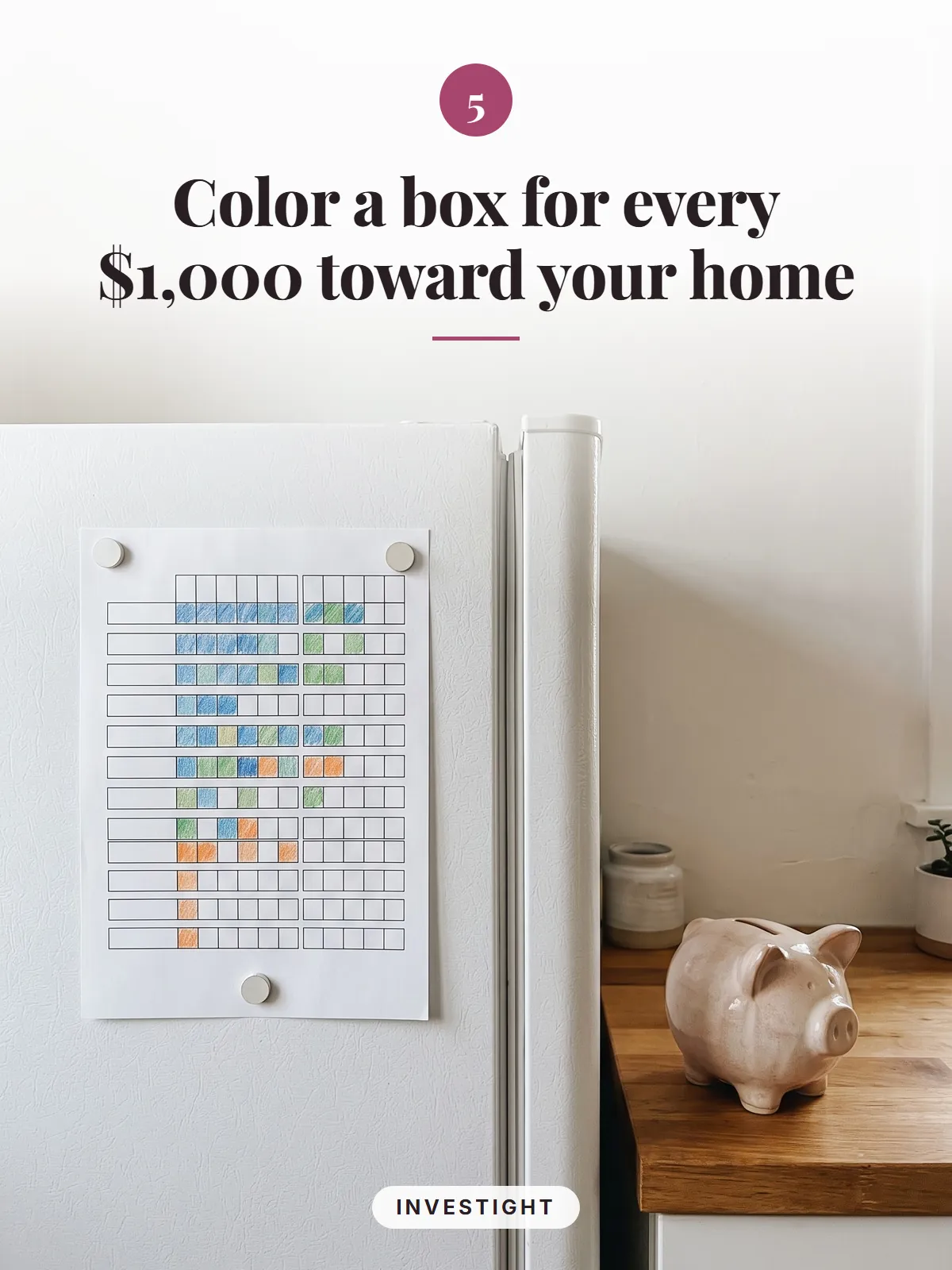
Seeing the boxes fill is what keeps you going in year two, when the excitement has faded but the goal is finally getting close.
How Long It Takes to Save for a House
This table shows how long a $25,000 house fund takes at different monthly amounts. It is the fastest way to set a realistic timeline.
| Monthly Savings | Time to Reach $25,000 |
|---|---|
| $400 | About 5 years 3 months |
| $520 | About 4 years |
| $700 | About 3 years |
| $1,050 | About 2 years |
| $1,400 | About 1 year 6 months |
Interest from a high-yield savings account shortens these timelines a little. Windfalls, raises and side income shorten them a lot.
Where to Find $694 a Month: A Real Example
Here is how one renter household with $4,800 of monthly take-home pay builds a $694 monthly house fund without a second job.
| Source | Monthly Amount |
|---|---|
| Current savings, redirected to the house fund | $200 |
| Meal planning and fewer takeout nights | $180 |
| Cheaper phone and internet plans | $50 |
| One streaming service and one subscription canceled | $25 |
| Car insurance shopped at renewal | $40 |
| Side income, about four hours a week | $200 |
| Total | $695 |
None of these changes is dramatic on its own. Together, they turn a vague dream into a three-year plan. Any raise or windfall along the way shortens it further.
What Lenders Look At Besides Your Savings
Your down payment is only one part of a mortgage approval. Lenders also look at your credit score, your income history and your debt-to-income ratio, which compares your monthly debt payments with your gross monthly income.
Paying down credit cards and avoiding new loans while you save can improve both your credit score and your debt-to-income ratio. That can mean a better rate and a lower monthly payment.
Lenders may also want to see cash reserves left over after closing, often a few months of mortgage payments. Your cushion line in the house fund helps here. Keep pay stubs, tax returns and bank statements organized, because you will need them when you apply.
Getting Preapproved Before You Shop
Once your house fund is close to your goal, talk to two or three lenders about preapproval. A preapproval shows how much you can likely borrow and what your monthly payment might be, which helps you shop for homes you can actually afford.
Compare loan estimates side by side, including the interest rate, closing costs and any lender fees. Small differences in rate or fees add up over a 30-year loan. Ask each lender about first-time homebuyer programs and down payment assistance they work with.
How to Save Money for a House on One Income
Saving for a house on one income takes longer, but it is very possible with a focused plan. Start by keeping your housing and car costs as low as you can while you save, because those two lines decide how much is left each month.
Look closely at first-time homebuyer programs, since many are designed for moderate incomes. A lower-priced starter home, a condo or a home in a nearby town can also bring the goal within reach sooner.
Add one steady extra income stream, even a few hours a week, and send all of it to the house fund. On one income, every extra $200 a month can shorten the timeline by many months.
Saving for a House as a Couple
Couples can save for a house much faster by living on one income and banking the other, or by saving a set share of both paychecks. If one partner takes home $2,000 a month and all of it goes to the house fund, a $25,000 goal takes just over a year.
Agree on the target price, the timeline and the monthly amount together. Open one shared house fund, keep one shared tracker and review progress once a month. Decide in advance how you will handle big expenses, so the house fund is not raided by surprise.
Should You Use Retirement Money for a House?
Some rules allow first-time homebuyers to withdraw up to $10,000 from an IRA without the usual 10% early withdrawal penalty, though income tax may still apply on traditional IRA money. Some 401(k) plans allow loans that are repaid through your paycheck.
These options can help, but they reduce your retirement savings and can carry real costs if things go wrong, such as having to repay a 401(k) loan quickly if you leave your job. Treat them as a last step and talk to a tax professional before using them.
Costs to Plan for After You Buy
Owning a home brings new costs that renters do not pay. Plan for them while you save, so the first year in your home is not a financial shock.
Property taxes and homeowners insurance are often added to your monthly mortgage payment. Maintenance and repairs are a separate cost; many owners set aside about 1% of the home's value each year, which is $3,000 a year on a $300,000 home.
Utilities, furniture, tools and lawn care often cost more than in an apartment. Keeping a cushion in your house fund, separate from the down payment, means a broken water heater in month two does not land on a credit card.
How to Stay Motivated Through a Multi-Year Goal
A house fund can take two to five years, which is a long time to stay focused. Break it into milestones: every $5,000 is a real win worth celebrating with something small and low cost.
Keep a photo of the kind of home or neighborhood you want on your tracker. Drive through neighborhoods you like once in a while, or tour an open house, to remind yourself what the deposits are for.
Review your plan every six months. If your income rose, raise the monthly amount. If life got harder, lower it rather than stopping. Steady progress, even slower than planned, still gets you home.
House Saving Mistakes to Avoid
Saving only for the down payment. Closing costs and moving often add thousands more. Include them from the start.
Keeping the house fund in checking. It slowly disappears into everyday spending. Use a separate, named account.
Investing a short-term house fund in stocks. A market drop right before you buy can delay your plans. Keep money you need within a few years in savings or CDs.
Draining your emergency fund. Lenders like to see reserves, and you will need a cushion after you move in. Keep emergency savings separate from the house fund.
Opening new credit right before you apply. A new car loan or credit card can affect your loan approval. Keep your credit steady until after closing. You can find more ways to save on everyday costs in our frugal living guides.
Frequently Asked Questions
How much should I save for a house?
Plan for the down payment, closing costs of about 2% to 5% of the loan, moving costs and a cash cushion. For a $300,000 home with 3.5% down, a total of about $25,000 is a realistic goal.
Do I need 20% down to buy a house?
No. Some conventional loans allow as little as 3% down for qualifying first-time buyers, and FHA loans allow 3.5% with a qualifying credit score. With less than 20% on a conventional loan, you usually pay mortgage insurance.
How long does it take to save for a down payment?
It depends on your goal and monthly savings. Saving $700 a month reaches $25,000 in about three years, and $1,050 a month reaches it in about two.
Where should I keep my house savings?
In a separate high-yield savings account, or in CDs for money you will not need for a year or more. Avoid stocks for a house fund you plan to use within a few years.
Are there programs to help first-time homebuyers?
Yes. Many state and local housing agencies offer down payment assistance, grants or special loans, often with income limits. Ask lenders and your state's housing finance agency.
Can I use gift money for a down payment?
Many loans allow gift money from family, but lenders usually require a gift letter and records showing where the money came from. Ask your lender before the money is deposited.
Should I pay off debt or save for a house first?
Pay off high-interest debt like credit cards first if you can, because it improves your credit and your debt-to-income ratio. Lower-interest debt, like a student loan, can usually be paid on schedule while you save.
Is it better to rent longer and save more?
Often, yes. Renting a little longer to build a bigger down payment and cushion can mean a lower monthly payment and less stress after you buy. The right timing depends on your local market and your plans.
What credit score do I need to buy a house?
It depends on the loan. FHA loans can allow lower scores than many conventional loans, but a higher score usually means a better rate. Ask lenders what score each program requires before you apply.
Start Your House Fund This Month
Buying a home starts long before the house hunt. Set your full goal, find your monthly number and automate the first transfer this month.
Then keep going, one deposit and one colored box at a time. Knowing how to save money for a house is mostly about patience and a plan, and both start today.

Pin this guide to your money board
Save this saving money guide on Pinterest so the numbers and checklist are there when you need them.
Save on PinterestThis guide is general education, not individualized financial, tax, or investment advice. Figures reflect rules in effect on Nov 21, 2026. See our financial disclaimer.
